
Bookkeeping and Making Tax Digital (MTD) for self-employed beauty therapists and nail technicians
Gel sets in your home studio in the morning, a mobile pedicure in the afternoon, and receipts for polish, files and lamps in every bag. Pulse keeps your takings, miles and product costs in one place, ready for Making Tax Digital.
- Log the miles to mobile clients on your phone
- Claim your home studio the way that suits you
- Send your quarterly updates and tax return straight to HMRC
Jess’s Thursday
Home studio and mobile-
Opens the home studio9:00am
-
Gel manicure, home studio9:30am, paid by card£30
-
Acrylic infills, home studio£35 infills plus an £8 cuticle oil, paid by bank transfer£43
-
Mrs Patel, Elm GroveMobile gel pedicure, paid in cash£354.5 miles from home
-
Bridal party, The WillowsThree gel manicures, on an invoice£906.0 miles
-
Back home5:30pm8.5 miles
When Making Tax Digital starts for you
Making Tax Digital for Income Tax means keeping your records digitally and sending HMRC a short update every three months, then a final declaration after the tax year ends. Whether you're in depends on your turnover, the total you charge your customers before any expenses, not your profit.
- From 6 April 2026Over £50,000Already started
- From 6 April 2027Over £30,000Based on your 2025/26 tax return
- From 6 April 2028Over £20,000Based on your 2026/27 tax return
An example. You take £700 a week from treatments and the aftercare products you sell, and take six weeks off a year. That’s 46 weeks × £700, or £32,200 of turnover. Product sales count towards turnover too. If your 2025/26 tax return shows that, you’ll need to use Making Tax Digital from 6 April 2027.
The quarterly updates are due by 7 August, 7 November, 7 February and 7 May. If you have other self-employed work or rent out a property, that income counts towards the total too. When do I need to start?
Home studio or mobile?
This is where beauty therapists and nail techs most often under-claim. Lots of you do both, so it’s worth getting right.
Working from a room at home
If clients come to you, you can claim part of your household costs. There are two ways to do it, and you choose one.
The flat rate. Count the hours you work at home each month. Time with clients in your studio counts, and so does your admin. Once you’re over 25 hours, you claim a fixed amount for that month from the table. No bills to divide up.
A share of the actual costs. Work out how much of your home the room takes up, and how much of the time it’s used for work. Then claim that share of your heating, electricity, council tax and rent or mortgage interest. Keep the bills.
An example. Your gas and electricity come to £2,000 a year and your home has five rooms. One of them is your nail studio and you only use it for work, so you could claim a fifth, or £400 a year. On the flat rate, working 120 hours a month at home would give you £26 × 12, or £312.
Either way, you can claim the business share of your phone and broadband on top. A room used only for work, especially one that’s been fitted out and that clients visit, can sometimes attract business rates. If you’re setting a room aside just for clients, ask us which way of claiming suits you.
Read more about simplified expenses, property costs and phone and broadband.
| Hours worked at home | Per month |
|---|---|
| 25 to 50 hours | £10 |
| 51 to 100 hours | £18 |
| 101 hours or more | £26 |
Going out to clients
If home is your base and you travel to different clients’ homes, wedding venues or care homes, those journeys are usually business travel. That includes the drive from home to your first client and back again at the end of the day.
It’s different if you rent a chair or room in the same salon and go there every day. That’s ordinary commuting, which you can’t claim.
| Car or van | Per mile |
|---|---|
| First 10,000 business miles | 55p |
| Every mile after that | 25p |
If you claim mileage for a car, you can’t also claim its fuel or running costs. Parking at a client’s is claimable, but parking fines aren’t. Read more about cars, vans and mileage and parking charges.
What you can claim as a beauty therapist or nail tech
Every allowable expense brings down the profit you pay tax and National Insurance on. These are the ones beauty therapists and nail techs claim most. Keep the receipt for each, or scan it into Pulse.
Products and consumables
Gel polish, acrylic powder, files, wipes, wax, lash glue, cotton pads, disposable gloves and towels you use on clients.
Kit and equipment
UV and LED lamps, nail drills, a treatment couch, wax heaters and your mobile kit bag. Bigger items may need to go in as a capital allowance.
Training courses
Courses that update or build on what you already do, like a nail tech learning a new extension system. A course to start a different business usually isn’t claimable. Training costs
Insurance and licences
Treatment and public liability insurance. If your council needs you to hold a licence or registration for the treatments you offer, the fee counts too.
Stock you sell to clients
Cuticle oils, aftercare and skincare you buy to sell on. The cost is an expense and the sale is income. Stock for resale
Tunics and protective wear
A salon tunic or a top with your business name on, plus aprons and masks. Everyday clothes don’t count. Clothing expenses
Advertising and booking apps
Instagram ads, business cards, a simple website and your online booking subscription. Marketing costs
Card machine fees
Fees charged by SumUp, Square and similar on card payments. Card payment charges
What you can’t claim
- Everyday clothes and shoes, even plain black ones you only wear for work
- Your own hair, nails or beauty treatments
- Products you use on yourself, or on friends and family for free
- Parking and speeding fines
For the full list, see Allowable expenses, what are they?
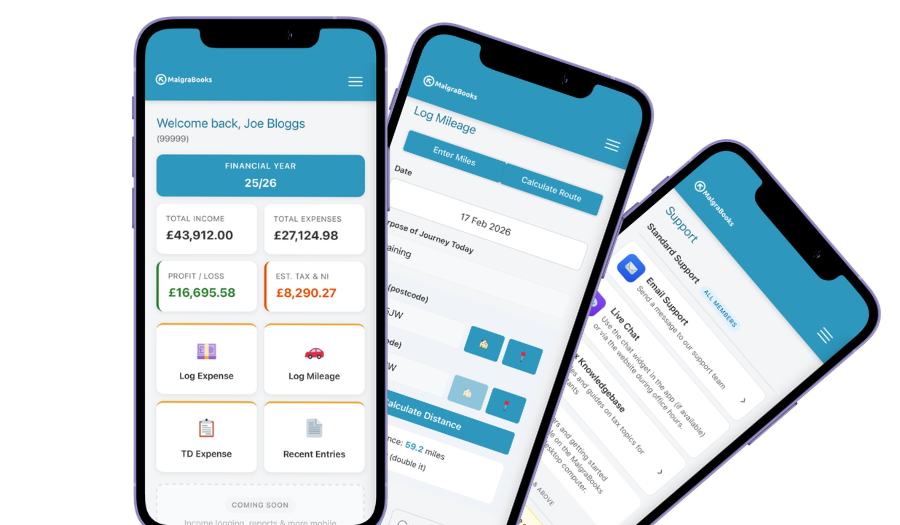
Access your accounts on your mobile
Designed for iPhone and Android phones, so you can add a payment, log a journey or scan a receipt between jobs, and check your reports and tax as you go.
See the mobile appHow Pulse helps
Pulse is our online bookkeeping system, with apps for iPhone and Android. Here’s what beauty therapists and nail techs use most.
Scan your receipts
Polish, files, wipes and wax add up fast. Take a photo of each receipt in the app and it’s saved against the expense, so nothing gets lost in your kit bag.
Receipt scannerMileage on your phone
Enter postcodes or use your location, and Pulse works out the miles. Save regular mobile clients in your address book so each journey takes seconds.
Logging mileageHome studio hours
Record the hours you work at home, including time with clients in your studio, and Pulse gives you the working from home allowance for each month.
Working from homeQuotes for weddings and events
Send a bride a quote for the whole party. When she says yes, turn it into an invoice in one click.
QuotesGet paid by card
Add your Stripe, SumUp or PayPal.Me link and a Pay online button appears on your invoices. The money goes straight to you, and part payments are tracked.
Online paymentsStraight to HMRC
Pulse is recognised by HMRC for Making Tax Digital. Send your quarterly updates from Pulse, and your tax return if you choose that package.
Sending MTD updatesEverything in one package
Small Business Complete includes everything on this page. There are no invoice limits, and you can start partway through the year and add the months you've missed.
MalgraBooks is recognised by HMRC for Making Tax Digital. HMRC reference D5P1NR.
Small Business Complete
- Bookkeeping, invoicing and mileage in Pulse
- Unlimited receipt scanning
- Making Tax Digital quarterly updates
- Your tax return sent to HMRC
Questions beauty therapists and nail techs ask us
Do I need to register as self-employed?
If you earn more than £1,000 a year from treatments and product sales before expenses, yes. You need to register by 5 October after the end of the tax year you started in. For example, if you started in June 2026, that’s by 5 October 2027. How to register with HMRC
Clients often tip me. Do tips count as income?
Yes. When you’re self-employed, tips are part of your income and you pay tax on them, whether they’re in cash or added to a card payment. Add them in Pulse along with the treatment.
I’ve just bought a new LED lamp and a couch. Can I claim them this year?
Usually, yes. Equipment you buy for the business can normally be claimed in full in the tax year you buy it, either as an expense or as a capital allowance. If you also use something privately, you can only claim the business share. Capital allowances
Do I need a licence, and can I claim it?
It depends where you work and what you offer. Many London councils need premises offering manicures, pedicures, nail extensions or massage to hold a special treatment licence, though working only in clients’ own homes is usually exempt. Outside London, councils register people offering treatments such as electrolysis, semi-permanent make-up and cosmetic piercing. Check with your local council. If you do need one, the fee is a business expense.
I rent a room in a salon two days a week. Can I claim the travel there?
Travel to a salon you go to regularly usually counts as commuting, so it isn’t claimable, but the rent is. Trips out to mobile clients on your other days still count as business travel. Mixed patterns can be tricky, so ask us if you’re not sure. Venue rent
Do I need to register for VAT?
Only if your turnover, including product sales, goes over £90,000 in any rolling 12 months. Most self-employed beauty therapists and nail techs are well under this. VAT explained
Got a question that isn't here? Send us a message and the team will get back to you.