
Bookkeeping and Making Tax Digital (MTD) for self-employed carers
Morning calls, lunches, sits and teatime visits, with the miles between them adding up all day. Some clients pay you themselves, some pay from their direct payments, and the paperwork waits until you get home. Pulse keeps it in one place, from your mileage to your Making Tax Digital updates.
- Log the miles between clients’ homes on your phone
- Send weekly invoices to clients and families automatically
- Send your quarterly updates and tax return straight to HMRC
Ruth’s Monday
£20 an hour-
Leaves home7:30am
-
Mr Hughes, Station Road8:00am, 1 hour, getting up and breakfast£202.4 miles from home
-
Mrs Patel, Elm Grove9:30am, 1 hour, paid from her direct payments£203.1 miles
-
Margaret, Oak Lane11:00am, 2 hours, company and a trip to the shops£404.5 miles
-
Mr Hughes, Station Road1:30pm, ½ hour, lunch call£103.0 miles
-
Dennis, Mill Street3:30pm, 2 hours, sitting service, invoiced to his daughter£401.8 miles
-
Back home6:00pm4.2 miles
When Making Tax Digital starts for you
Making Tax Digital for Income Tax means keeping your records digitally and sending HMRC a short update every three months, then a final declaration after the tax year ends. Whether you're in depends on your turnover, the total you charge your customers before any expenses, not your profit.
- From 6 April 2026Over £50,000Already started
- From 6 April 2027Over £30,000Based on your 2025/26 tax return
- From 6 April 2028Over £20,000Based on your 2026/27 tax return
An example. You work 22 hours a week at £20 an hour and take four weeks off a year. That’s 48 weeks × £440, or £21,120 of income before expenses. That’s under £30,000, so April 2027 doesn’t catch you. But if your 2026/27 tax return shows £21,120, it’s over £20,000, so you’ll need to use Making Tax Digital from 6 April 2028.
The quarterly updates are due by 7 August, 7 November, 7 February and 7 May. If you have other self-employed work or rent out a property, that income counts towards the total too. When do I need to start?
Are you really self-employed?
It’s worth checking this first. If you work through a care agency and they pay you through payroll, with tax and National Insurance taken off, you’re employed, not self-employed. That work stays on your payslip and doesn’t go in your self-employed records.
Working directly for clients, or for people who pay you from their direct payments, is often self-employed. But not always. These point towards being someone’s employee:
- You work set hours for one person, and they decide how the work is done
- You can’t send someone else in your place
- You get holiday pay or sick pay
You can be employed by an agency and self-employed with your own private clients at the same time. Only the self-employed part goes in Pulse, and agency wages don’t count towards the Making Tax Digital threshold.
Getting it wrong can cause problems for you and the person you work for. If you’re not sure, use HMRC’s check employment status for tax tool, or ask us.
Travelling between clients’ homes
For most self-employed carers, mileage is the biggest expense. If you run your business from home and visit different clients in their homes, those journeys are usually business travel. That includes the drive from home to your first client, the trips in between, and the drive home at the end of the day.
It adds up. Ten miles a day, five days a week for 46 weeks is 2,300 miles. At 55p a mile, that’s £1,265 off your profit.
It’s different if you care for one person, at their home, every day. That can look more like ordinary commuting, which you can’t claim. If that sounds like you, ask us before you claim it.
If you don’t drive, bus and train fares between clients count too. Parking near a client’s home is claimable, but parking fines aren’t.
Read more about cars, vans and mileage, parking charges and fines.
| Car or van | Per mile |
|---|---|
| First 10,000 business miles | 55p |
| Every mile after that | 25p |
The mileage rate covers fuel, insurance, servicing and wear and tear, so you can’t also claim those for the same car. Once you’ve used the mileage rate for a vehicle, you keep using it for as long as you use that vehicle for work.
If a client pays you extra for the miles when you take them shopping or to an appointment, that money is income. You still log the journey.
What you can claim as a carer
Every allowable expense brings down the profit you pay tax and National Insurance on. These are the ones carers claim most. Keep the receipt for each, or scan it into Pulse.
Gloves, aprons and PPE
Disposable gloves, aprons, masks and hand gel you buy and use on visits.
DBS check
The fee for your own DBS check, and the Update Service if you use it. From 5 October 2026 an enhanced check is £41 and the Update Service is £15 a year. Umbrella bodies may add their own admin fee, which you can claim too.
Training
Courses that keep your skills up to date, like moving and handling, first aid or medication training. Training for a completely new kind of work usually isn’t allowed. Training costs
Insurance
Public liability and professional indemnity cover. Your car insurance is already covered by the mileage rate, so don’t claim it again.
Phone
The business share of your mobile, for calls and texts with clients, families and the council. Phone and broadband
Uniform and protective clothing
A tunic with your business name on, or protective wear. Everyday clothes don’t count. Clothing expenses
Advertising
Business cards, leaflets, or a fee to be listed on a website where families look for carers. Marketing costs
Admin at home
If you spend 25 hours or more a month on admin at home, you can claim a flat rate of £10 to £26 a month. Simplified expenses
What you can’t claim
- Everyday clothes and shoes, even if you only wear them for work
- Parking and speeding fines
- Fuel and car costs, if you claim the mileage rate for that car
- Shopping you buy for a client that they pay you back for
For the full list, see Allowable expenses, what are they?
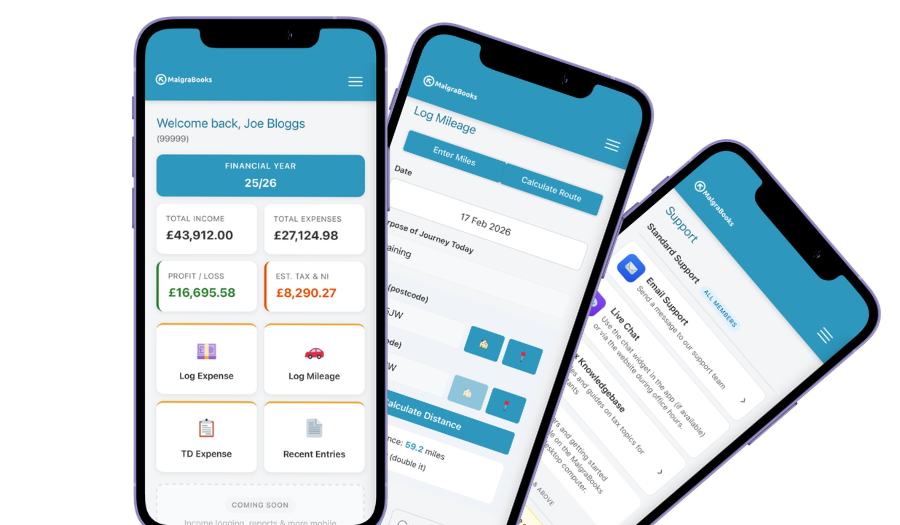
Access your accounts on your mobile
Designed for iPhone and Android phones, so you can add a payment, log a journey or scan a receipt between jobs, and check your reports and tax as you go.
See the mobile appHow Pulse helps
Pulse is our online bookkeeping system, with apps for iPhone and Android. Here’s what carers use most.
Mileage on your phone
Enter postcodes or use your location, and Pulse works out the miles. Save each client in your address book so logging a visit takes seconds, even between calls.
Logging mileageRecurring invoices
Set up a client once and Pulse creates their invoice every week, fortnight, four weeks or month. Send it to them or their family automatically, or check it first.
Recurring invoicesScan your receipts
Take a photo of the receipt for your gloves, aprons or a training course in the app, and it’s saved against the expense.
Receipt scannerRegular costs remembered
Your phone bill, insurance and DBS Update Service come round again and again. Add them as recurring expenses and Pulse asks you to confirm each one when it’s due.
Recurring expensesWorking from home
Rotas, invoices and messages to families all take time at home. Log your hours and Pulse works out the flat rate allowance for you.
Working from homeStraight to HMRC
Pulse is recognised by HMRC for Making Tax Digital. Send your quarterly updates from Pulse, and your tax return if you choose that package.
Sending MTD updatesEverything in one package
Small Business Complete includes everything on this page. There are no invoice limits, and you can start partway through the year and add the months you've missed.
MalgraBooks is recognised by HMRC for Making Tax Digital. HMRC reference D5P1NR.
Small Business Complete
- Bookkeeping, invoicing and mileage in Pulse
- Unlimited receipt scanning
- Making Tax Digital quarterly updates
- Your tax return sent to HMRC
Questions carers ask us
Do I need to register as self-employed?
If you earn more than £1,000 a year from self-employed care work before expenses, yes. You need to register by 5 October after the end of the tax year you started in. For example, if you started in June 2026, that’s by 5 October 2027. How to register with HMRC
I work for an agency and have a few private clients. What goes in Pulse?
Only your private clients. Your agency pays you through payroll, so tax is already taken off those wages. They still go on your tax return, but they’re not part of your self-employed income, and they don’t count towards the Making Tax Digital threshold.
My client pays me from their direct payments. Is that my income?
Yes. Whatever they pay you for your work is your self-employed income, wherever the money comes from. Some clients or councils like an invoice for each payment, and you can send those from Pulse.
I buy a client’s shopping and they pay me back. Do I record it?
If they pay you back exactly what you spent, it isn’t your income or your expense, so it doesn’t go in your books. Keep the receipt and give them the change, so everyone can see where the money went.
A family gave me money to say thank you. Is that taxable?
If it’s given because of the care you provide, it counts as a tip, and tips are taxable income for self-employed people. Add it in Pulse as income on the day you receive it.
How long do I need to keep my records?
At least five years after the 31 January deadline for that tax year. Records and receipt photos in Pulse count, so you don’t need to keep paper copies as well. Keeping records
Got a question that isn't here? Send us a message and the team will get back to you.