
Bookkeeping and Making Tax Digital (MTD) for self-employed delivery drivers and couriers
A parcel block in the morning, a few hours of food orders after tea, and a payout from each app at the end of the week. When you deliver for yourself, most of your money comes in through an app and most of your costs come from the miles. Pulse keeps your payouts, your mileage and your Making Tax Digital updates in one place, in a car, a van, on a motorbike or on a bike.
- Log your miles on your phone after each block or shift
- Add each app’s weekly payout in a few taps
- Send your quarterly updates and tax return straight to HMRC
Marcus’s Thursday
Parcels by day, food by night-
Leaves home9:00am, in his car
-
Delivery station, Trafford ParkLoads up for a 4-hour Amazon Flex block6.5 miles from home
-
Parcel round, Stretford and Sale38 drops, paid in the app’s weekly payout£6831.0 miles
-
Home for a break2:00pm8.5 miles
-
Food orders around Altrincham5:30pm to 9:30pm, 16 orders on Deliveroo and Uber Eats, including £10 of tips£8024.0 miles
-
Back home9:45pm3.0 miles
When Making Tax Digital starts for you
Making Tax Digital for Income Tax means keeping your records digitally and sending HMRC a short update every three months, then a final declaration after the tax year ends. Whether you're in depends on your turnover, the total you charge your customers before any expenses, not your profit.
- From 6 April 2026Over £50,000Already started
- From 6 April 2027Over £30,000Based on your 2025/26 tax return
- From 6 April 2028Over £20,000Based on your 2026/27 tax return
An example. You do four parcel blocks and three evenings of food orders most weeks, earning about £650 a week, tips included, for 48 weeks of the year. That’s £31,200 of turnover. If your 2025/26 tax return shows that, you’ll need to use Making Tax Digital from 6 April 2027. If you deliver alongside a job, only your delivery income counts towards the threshold, not your wages.
The quarterly updates are due by 7 August, 7 November, 7 February and 7 May. If you have other self-employed work or rent out a property, that income counts towards the total too. When do I need to start?
Your miles, your payouts and what the apps tell HMRC
For most delivery drivers the vehicle is the biggest cost by a long way. It’s also where we see the most mistakes, along with income figures that don’t match what the apps have paid.
Mileage or actual costs. You can claim a flat rate for every business mile, which covers fuel, insurance, servicing, tyres and wear and tear. Or you can claim the business share of what you really spend running the vehicle, plus capital allowances on the vehicle itself. You choose for each vehicle. Once you’ve used the flat rate for a vehicle, you keep using it for as long as it’s in your business, and you can’t move to the flat rate for a vehicle you’ve already claimed capital allowances on.
High mileage. At 250 business miles a week, you’d reach 10,000 miles in 40 weeks, and the car and van rate drops to 25p after that. If your van is thirsty or expensive to run, actual costs can come out ahead. The choice sticks, so ask us before your first tax return.
Which miles count. The round itself, driving between restaurants and customers, and setting off from home when your business is run from home usually all count. The drive to a depot or delivery station you go to every day is less clear cut, so ask us if that’s you. Personal trips in between don’t count.
Delivering by bike. HMRC’s flat rates are for cars, vans and motorbikes. On a pedal bike or e-bike, you claim what you actually spend instead, like the bike, repairs, tyres and lights. You may see 20p a mile quoted for bikes, but that’s a rate employers can pay their staff.
Your payouts are your income. If you deliver through apps or depots such as Amazon Flex, Evri, DPD, Deliveroo, Uber Eats or Just Eat, keep every pay statement. What you earned for the work, including tips and any bonuses, is your income. Check each statement for anything taken off before you’re paid, such as a hire or equipment charge. If there is, record the amount before the charge as income and the charge as an expense, so your turnover is right.
The apps tell HMRC. Since 1 January 2024, digital platforms have had to collect details of the people who earn through them and report what they paid to HMRC each year. The first reports went in by 31 January 2025, and gov.uk gives delivering food as an example. The small-seller exemption only covers selling goods, not services like delivery. The platform must give you a copy of what it reports. That doesn’t mean you owe tax, but HMRC can see what you were paid, so make sure your own figures add up. Selling goods or services on a digital platform (gov.uk)
Read more about cars, vans and mileage, simplified expenses and capital allowances.
| Vehicle | Per mile |
|---|---|
| Car or van, first 10,000 business miles | 55p |
| Car or van, every mile after that | 25p |
| Motorbike, any number of miles | 24p |
If you claim mileage for a vehicle, you can’t also claim its fuel, insurance or repairs. Parking and tolls on business journeys can go in on top. Simplified expenses for vehicles (gov.uk)
| 12,000 business miles | Claim |
|---|---|
| First 10,000 miles at 55p | £5,500 |
| Next 2,000 miles at 25p | £500 |
| Mileage claim for the year | £6,000 |
Actual costs would only beat this if the business share of fuel, insurance, repairs and capital allowances came to more than £6,000.
| What the apps show | Dates |
|---|---|
| Your tax year | 6 April to 5 April |
| Some app summaries | 1 January to 31 December |
If an app’s yearly summary runs January to December, add up your weekly payouts for the tax year instead. Recording each one in Pulse as it lands does this for you.
What you can claim as a delivery driver or courier
Every allowable expense brings down the profit you pay tax and National Insurance on. These are the ones delivery drivers and riders claim most. Keep the receipt for each, or scan it into Pulse.
Your car, van or motorbike
The flat mileage rate for each business mile, or the business share of actual running costs plus capital allowances. One method per vehicle. Cars, vans and mileage
Your bike
If you deliver by bike, the bike itself, repairs, tyres, lights, a lock and a pump. A new bike or e-bike may need to go in as a capital allowance.
Delivery kit
Insulated food bags, a delivery box for the bike or scooter, a sack truck for heavy parcels, and straps or crates to keep the boot tidy.
Phone and data
The business share of your phone contract and data, plus a phone mount, charging cable and power bank. Phone and broadband
Parking and tolls
Pay and display while you drop off, car parks at retail parks and bridge or tunnel tolls on business journeys, even if you claim mileage. Parking charges
Insurance
Goods in transit and public liability cover. If you claim mileage, your vehicle insurance, courier cover included, is already part of the flat rate.
Protective clothing
A hi-vis vest, a cycle or motorbike helmet and protective bike gear. Everyday coats and trainers don’t count. Clothing expenses
Bookkeeping costs
What you pay for bookkeeping software like Pulse, and for help with your tax return. Professional charges
What you can’t claim
- Fuel, insurance, servicing or tyres for a vehicle you claim mileage for
- Personal trips, like the school run between a parcel block and your evening shift
- Parking tickets, bus lane fines and speeding fines
- Everyday clothes, coats and shoes, even if you only wear them for deliveries
- Food and drink you buy for yourself during a shift
- Your actual costs, if you’ve taken off the £1,000 trading allowance instead
For the full list, see Allowable expenses, what are they? and vehicle or travel fines.
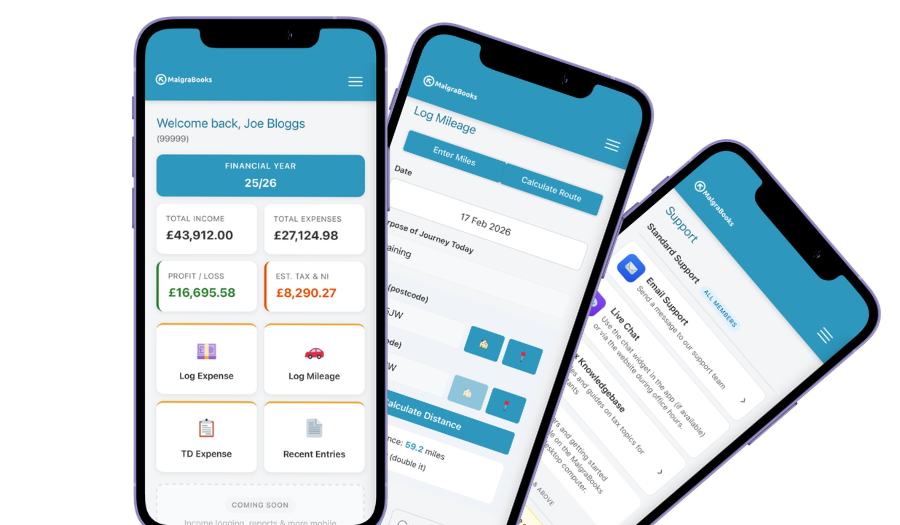
Access your accounts on your mobile
Designed for iPhone and Android phones, so you can add a payment, log a journey or scan a receipt between jobs, and check your reports and tax as you go.
See the mobile appHow Pulse helps
Pulse is our online bookkeeping system, with apps for iPhone and Android. Here’s what delivery drivers and riders use most.
Mileage on your phone
Enter postcodes or use your location, and Pulse works out the miles. Log each run when you finish a block or shift, while you still remember where you went.
Logging mileageEvery app’s payout in one place
Add each weekly payout as income when it reaches your bank, noting which app it came from. Parcels and food end up in one set of books, ready to check against each statement.
How quarterly updates workScan your receipts
Photograph the receipt for a new phone mount, an insulated bag or a car park ticket, and it’s saved against the expense before it fades in the glovebox.
Receipt scannerRegular costs remembered
Your phone contract and goods in transit cover come round every month. Add them as recurring expenses and Pulse asks you to confirm each one when it’s due.
Recurring expensesYour own courier customers
Do a regular run for a local pharmacy, florist or print shop? Set up a weekly or monthly recurring invoice, and Pulse sends it automatically or saves it as a draft for you to check.
Recurring invoicesStraight to HMRC
Pulse is recognised by HMRC for Making Tax Digital. Send your quarterly updates from Pulse, and your tax return if you choose that package.
When MTD starts for youEverything in one package
Small Business Complete includes everything on this page. There are no invoice limits, and you can start partway through the year and add the months you've missed.
MalgraBooks is recognised by HMRC for Making Tax Digital. HMRC reference D5P1NR.
Small Business Complete
- Bookkeeping, invoicing and mileage in Pulse
- Unlimited receipt scanning
- Making Tax Digital quarterly updates
- Your tax return sent to HMRC
Questions delivery drivers and couriers ask us
I only deliver a few evenings a week alongside my job. Do I need to register?
If all your self-employed income added together is more than £1,000 in a tax year before any costs, yes, even with a job as well. That’s every delivery app plus any other self-employed work, as one total. You need to register by 5 October after the end of the tax year you started in. If you started in June 2026, that’s by 5 October 2027. How to register with HMRC
Should I take the £1,000 trading allowance or claim my miles?
You can take off one or the other, not both. Drivers often do better claiming their miles. Say you earn £4,000 from evening deliveries and drive 3,000 business miles. At 55p, that’s £1,650 of mileage, before your phone and kit, against £1,000 for the allowance.
Do tips count as income?
Yes. Tips are part of your self-employed income, whether a customer adds them in the app or hands you cash at the door. If an app pays tips in with your weekly payout, they’re already in the figure you record.
The app’s yearly summary doesn’t match my figures. Which is right?
Often both are, for different dates. Some apps total the calendar year, but your tax return runs from 6 April to 5 April. Use your own records of the payouts for the tax year. If the totals still don’t match, check the statements for tips, bonuses or charges you’ve missed.
I work for two or three apps. Do I need separate books for each?
Usually not. Delivering parcels and food is normally one self-employed business, so it all goes in one set of records. Note which app each payout came from so you can check it against their statements. If you also do something quite different, like dog walking, ask us how to set it up.
How long do I need to keep my mileage records?
At least five years after the 31 January deadline for that tax year, along with your app statements and receipts. Your mileage log and receipt photos in Pulse count, so you don’t need paper copies as well. Keeping records
Got a question that isn't here? Send us a message and the team will get back to you.
Amazon Flex, Evri, DPD, Deliveroo, Uber Eats and Just Eat are trade marks of their owners. MalgraBooks isn’t connected with any of them.