
Bookkeeping and Making Tax Digital (MTD) for self-employed driving instructors
You spend the day in the passenger seat, your pupils pay by bank transfer, by card or for a block of lessons up front, and the car clocks up miles every hour. Pulse keeps it all in one place, from lesson payments and car costs to your Making Tax Digital updates.
- Log the miles between pupils on your phone
- Invoice block bookings and take payments online
- Send your quarterly updates and tax return straight to HMRC
Lee’s Wednesday
£40 an hour-
Leaves home8:00am
-
Megan, Highfield Road2-hour lesson, paid by bank transfer£803.0 miles from home
-
Callum, Brook Street1 hour, from a 10-hour block on his invoice£4029.5 miles, Megan’s lesson and the drive over
-
Zainab, Moss Lane2 hours with a mock test, paid by card£8015.0 miles, Callum’s lesson and the drive over
-
Harry, Victoria Avenue1½ hours after school, paid online from his invoice£6028.0 miles, Zainab’s lesson and the drive over
-
Back home5:45pm22.5 miles, Harry’s lesson and the drive home
When Making Tax Digital starts for you
Making Tax Digital for Income Tax means keeping your records digitally and sending HMRC a short update every three months, then a final declaration after the tax year ends. Whether you're in depends on your turnover, the total you charge your customers before any expenses, not your profit.
- From 6 April 2026Over £50,000Already started
- From 6 April 2027Over £30,000Based on your 2025/26 tax return
- From 6 April 2028Over £20,000Based on your 2026/27 tax return
An example. You teach 25 hours a week at £40 an hour and take six weeks off a year. That’s 46 weeks × £1,000, or £46,000 of turnover. The test uses turnover, before your car costs or franchise fee come off. It’s over £30,000, so if your 2025/26 tax return shows that, you’ll need to use Making Tax Digital from 6 April 2027.
The quarterly updates are due by 7 August, 7 November, 7 February and 7 May. If you have other self-employed work or rent out a property, that income counts towards the total too. When do I need to start?
Mileage rate or actual car costs?
Your car is the biggest cost in the business, so this is the choice that matters most. There are two ways to claim for it. Once you’ve picked one for a car, you stay with it for as long as you use that car for work.
The mileage rate. You claim 55p a mile for the first 10,000 business miles in the tax year and 25p a mile after that. It covers fuel, insurance, servicing, repairs and wear and tear, so all you need is a good mileage log. Parking goes on top.
Actual costs. You add up what the car really costs to run, such as fuel, insurance, servicing, repairs, tyres and vehicle tax. On top of that you claim a capital allowance for the car itself. Cars, including dual-control cars, can’t use the annual investment allowance, so the cost is spread over the years. It’s 14% a year for a car with CO2 emissions of 50g/km or less, and 6% for anything higher. A brand new electric car can currently be claimed in full in the first year.
An instructor’s car does a lot of miles, and most of them come after the first 10,000, where the rate drops to 25p. Dual-control insurance, clutches, brakes and tyres cost more too. So actual costs can come out ahead, but it’s often close. It depends on your car, your miles and how much you drive it privately. Ask us before you decide.
Only the business share counts. Lessons, driving between pupils and trips to the test centre are business. If you work from home and pick pupils up from different places, the drive to your first pupil and home from your last is usually business too. The school run and weekends away aren’t. Note the reading on the clock at the start and end of the tax year, so you know the car’s total miles.
Read more about cars, vans and mileage, capital allowances and parking charges.
| 2026/27 | Claim |
|---|---|
| 10,000 miles at 55p | £5,500 |
| 12,500 miles at 25p | £3,125 |
| Mileage rate claim | £8,625 |
| Cost for the year | Amount |
|---|---|
| Fuel | £4,000 |
| Dual-control insurance | £2,400 |
| Servicing, repairs and tyres | £2,000 |
| Vehicle tax | £200 |
| Capital allowance, £20,000 car at 6% | £1,200 |
| Total | £9,800 |
| Business share, 90% | £8,820 |
In this example the car does 25,000 miles in the year, and 22,500 of them are for the business. Actual costs come out £195 ahead in the first year. Lower insurance or repair bills, or fewer miles, could tip it the other way.
What you can claim as a driving instructor
Every allowable expense brings down the profit you pay tax and National Insurance on. These are the ones driving instructors claim most. Keep the receipt for each, or scan it into Pulse.
Your car
Either the mileage rate or the business share of your actual costs, as explained above. Cars and mileage
Franchise fee
What you pay a driving school each week or month. If the fee includes the car, ask us how that fits with your car claim.
ADI registration
The £300 fee to renew your registration with DVSA every four years. Your standards check is free to book, so there’s nothing to claim for that.
Training
Courses that keep your instructing up to date or build on it, such as preparing for your standards check. Training costs
Business insurance
Public liability or professional cover for your instructing. Car insurance only counts if you claim actual car costs.
Parking
Parking while you wait at a test centre or drop a pupil off. You can claim this even if you use the mileage rate. Parking charges
Phone and adverts
The business share of your mobile, plus a roof sign, leaflets, a local Facebook ad or a simple website. Marketing costs
Card payment fees
Fees charged by SumUp, Stripe and similar when pupils pay by card. Card payment charges
What you can’t claim
- The private share of your car, such as the school run and weekends away
- Fuel, insurance or servicing for the car if you use the mileage rate
- Parking and speeding fines
- Everyday clothes, even smart ones you only wear for lessons
- Usually, the cost of training to qualify before you started teaching
For the full list, see Allowable expenses, what are they?
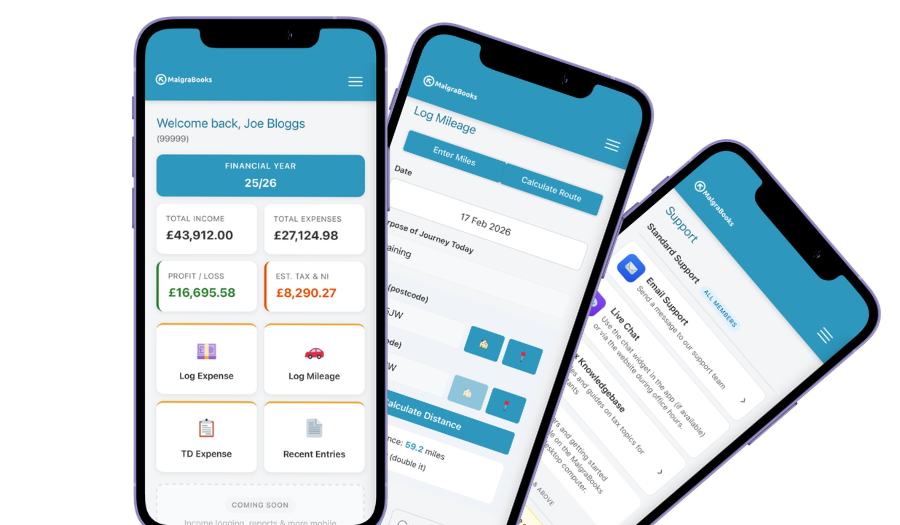
Access your accounts on your mobile
Designed for iPhone and Android phones, so you can add a payment, log a journey or scan a receipt between jobs, and check your reports and tax as you go.
See the mobile appHow Pulse helps
Pulse is our online bookkeeping system, with apps for iPhone and Android. Here’s what driving instructors use most.
Mileage on your phone
Enter postcodes or use your location, and Pulse works out the miles. Save pupils’ pick-up points and your local test centre in your address book so each journey takes seconds.
Logging mileageBlock bookings paid online
Put a block of lessons on one invoice and add your Stripe, SumUp or PayPal.Me link. Pupils pay with the Pay online button, the money goes straight to you, and part payments are tracked.
Online paymentsRecurring invoices
Got a pupil with the same slot every week? Set them up once and Pulse creates their invoice every week or fortnight. Send it automatically or check it first.
Recurring invoicesScan your receipts
If you claim actual car costs, every fuel and garage receipt counts. Take a photo in the app and it’s saved against the expense, so nothing gets lost in the glovebox.
Receipt scannerRegular costs remembered
Your franchise fee and phone bill come round like clockwork. Add them as recurring expenses and Pulse asks you to confirm each one when it’s due.
Recurring expensesStraight to HMRC
Pulse is recognised by HMRC for Making Tax Digital. Send your quarterly updates from Pulse, and your tax return if you choose that package.
Sending MTD updatesEverything in one package
Small Business Complete includes everything on this page. There are no invoice limits, and you can start partway through the year and add the months you've missed.
MalgraBooks is recognised by HMRC for Making Tax Digital. HMRC reference D5P1NR.
Small Business Complete
- Bookkeeping, invoicing and mileage in Pulse
- Unlimited receipt scanning
- Making Tax Digital quarterly updates
- Your tax return sent to HMRC
Questions driving instructors ask us
Do I need to register as self-employed?
If you earn more than £1,000 a year from teaching before expenses, yes. You need to register by 5 October after the end of the tax year you started in. For example, if you started in June 2026, that’s by 5 October 2027. How to register with HMRC
Pupils pay for a block of lessons up front. How do I record that?
Put the block on one invoice in Pulse. The money counts as income when the pupil pays it, even if the lessons are spread over the next few weeks. If they pay in instalments with the Pay online button, Pulse tracks each part payment. Online payments
I pay for a pupil’s driving test and they pay me back. How do I record it?
Record what the pupil pays you as income and the test fee as an expense, so the two cancel out. If the pupil books and pays DVSA themselves, there’s nothing for you to record.
Can I switch from the mileage rate to actual costs?
Not for the same car. Once you’ve used the mileage rate for a car, you keep using it for as long as you use that car for work. And if you’ve claimed capital allowances on a car, you can’t move it to the mileage rate. When you change car, you choose again. Cars, vans and mileage
My franchise fee includes the car. What can I claim?
The franchise fee is a business cost. Because part of it pays for the car, it ties in with how you claim for the car, so ask us and we’ll talk it through with you before you choose.
Do I need to register for VAT?
Only if your turnover goes over £90,000 in any rolling 12 months. Most self-employed driving instructors are well under this. VAT explained
Got a question that isn't here? Send us a message and the team will get back to you.