
Bookkeeping and Making Tax Digital (MTD) for eBay sellers and online resellers
You’re at the car boot before it’s light, round the charity shops by ten and in the post office queue by two. Your stock comes from all over, half of it paid for in cash, and your sales come in from eBay, Vinted and Depop. Pulse brings it together, from what you paid for stock to your Making Tax Digital updates.
- Note what you paid for stock, even when there’s no receipt
- Log trips to car boots and suppliers on your phone
- Send your quarterly updates and tax return straight to HMRC
Lauren’s Saturday
Car boot finds, sold online-
Leaves home6:30am
-
Car boot sale, Bolton Road7am, buys £40 of stock in cash, no receipts8.5 miles from home
-
Charity shops, Bridge StreetBuys £25 of stock, receipts kept3.5 miles
-
HomePhotographs and lists the morning’s finds6.0 miles
-
Sold on eBayA wax jacket and a cast iron casserole dish, £95 plus £10 postage£105
-
Sold on VintedA pair of vintage jeans£20
-
Post office, Albion RoadDrops off today’s 3 parcels1.5 miles
-
Back home2:00pm1.5 miles
When Making Tax Digital starts for you
Making Tax Digital for Income Tax means keeping your records digitally and sending HMRC a short update every three months, then a final declaration after the tax year ends. Whether you're in depends on your turnover, the total you charge your customers before any expenses, not your profit.
- From 6 April 2026Over £50,000Already started
- From 6 April 2027Over £30,000Based on your 2025/26 tax return
- From 6 April 2028Over £20,000Based on your 2026/27 tax return
An example. You sell £650 a week on eBay and Vinted, including the postage buyers pay you, and take four weeks off a year. That’s 48 weeks × £650, or £31,200 of turnover. It’s your sales that count, not your profit, so even if half of it went on stock, if your 2025/26 tax return shows that, you’ll need to use Making Tax Digital from 6 April 2027.
The quarterly updates are due by 7 August, 7 November, 7 February and 7 May. If you have other self-employed work or rent out a property, that income counts towards the total too. When do I need to start?
Decluttering or trading?
This is the question we’re asked most by online sellers. Selling your own unwanted things, usually for less than you paid, generally isn’t trading and isn’t taxed as income. Buying things to sell at a profit usually is, even if it started as a hobby.
HMRC weighs up a set of signs, known as the badges of trade. In plain English, it asks:
- Did you buy it to sell at a profit?
- Do you buy and sell regularly, or was it a one-off?
- Is it something people buy to use or enjoy, or only to sell on?
- Did you clean, repair or improve it to get a better price?
- Do you sell the way a shop would, with listings, photos and regular posting?
- Did you sell it soon after you bought it?
- Was it a gift or something you inherited? That’s less likely to be trading.
No single sign decides it. HMRC looks at the whole picture. If you buy at car boots and charity shops to sell online every week, you’re very likely trading.
The first £1,000 of trading income a year, before costs, is covered by the trading allowance, and you generally don’t need to tell HMRC. Above that you register as self-employed. You can use the £1,000 allowance instead of claiming costs, but not both, so if your stock and other costs come to more than £1,000, claiming them gives you a lower profit. If you’re not sure which side of the line you’re on, ask us.
HMRC’s own guide: selling online and paying taxes.
| Selling | Usually |
|---|---|
| Clothes your children have grown out of | Not trading |
| The contents of your loft or garage | Not trading |
| Car boot finds you list to sell for more | Trading |
| Charity shop stock you resell every week | Trading |
Online platforms send HMRC details of their sellers each year, unless a seller made fewer than 30 sales and took less than about £1,700 (€2,000) in the calendar year. Being reported doesn’t mean you owe tax. It just means HMRC knows you’ve been selling. The figure they send is after the platform’s fees, so it won’t match your turnover. Digital platform reporting on GOV.UK
Stock, sales and eBay fees
Your sales. Your turnover is the full amount the buyer paid, including any postage they paid you. It isn’t the smaller amount that lands in your bank. eBay takes its fees off before it pays you, so put the full sale in as income and the fees in as an expense.
Your stock. What you pay for stock is an expense. On the cash basis, the standard way for sole traders to keep their records, you claim stock when you pay for it, even if it hasn’t sold by the end of the year. If you use traditional accounting instead, stock you haven’t sold at the year end is taken off your costs until it sells. If you stop trading, the stock you’ve got left counts towards your income for that last year.
Getting it into Pulse. Pulse doesn’t connect to eBay or your bank. You add your sales from your eBay or Vinted statements, a week or a month at a time, and add the fees as an expense.
Read more about stock and goods for resale.
| The sale | Amount |
|---|---|
| Item price | £30 |
| Postage the buyer paid | £4 |
| Your sale, as income | £34 |
| eBay fees, as an expense | £5 |
| Paid out to you | £29 |
The fee here is a round example. eBay’s fees for business sellers include a final value fee, a per-order fee, and Promoted Listings if you use them. Your eBay statement shows what you paid.
What you can claim as an online reseller
Every allowable expense brings down the profit you pay tax and National Insurance on. These are the ones resellers claim most. Keep the receipt for each, or scan it into Pulse.
Stock
What you paid for the things you sell, from car boots, charity shops, clearance sales or wholesalers. Stock and goods for resale
Postage and packaging
Postage labels, boxes, mailing bags, tape and bubble wrap. Bigger kit like scales or a label printer may need to go in as a capital allowance.
Selling fees
eBay’s final value and per-order fees, Promoted Listings, your eBay shop subscription, and fees on any other site you sell through. Marketing and subscriptions
Getting stock ready
Cleaning products, repair materials and anything else you use to get items ready to sell.
Travel to buy stock
Mileage to car boots, charity shops, auctions and suppliers, and to the post office. Entry fees at a car boot count too. Cars, vans and mileage
Storage
Rent for a storage unit or lock-up that you use for stock. Office, property and equipment
Phone and broadband
The business share of your mobile and internet, which you use for listing, messaging buyers and checking prices. Phone and broadband
Working from home
If you spend 25 hours or more a month photographing, listing and packing at home, you can claim a flat rate of £10 to £26 a month. Simplified expenses
What you can’t claim
- Things you buy for yourself, even if you found them on a stock run
- Your own unwanted things that you sell, which stay out of your business records
- Everyday clothes, even the ones you wear to car boots
- Parking fines and other penalties
For the full list, see Allowable expenses, what are they?
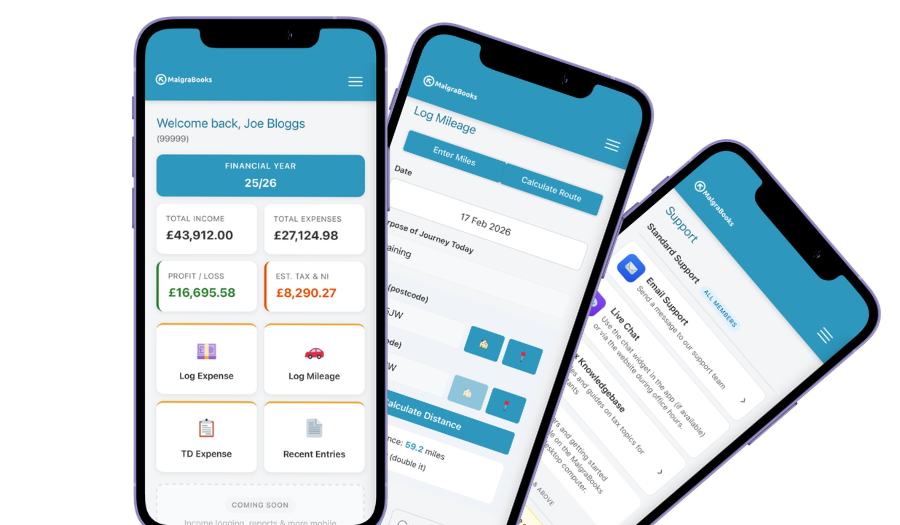
Access your accounts on your mobile
Designed for iPhone and Android phones, so you can add a payment, log a journey or scan a receipt between jobs, and check your reports and tax as you go.
See the mobile appHow Pulse helps
Pulse is our online bookkeeping system, with apps for iPhone and Android. Here’s what online resellers use most.
Stock, with or without a receipt
Charity shops give receipts, car boot sellers rarely do. Scan a receipt when you get one, and when you don’t, add the expense in the app there and then with a note of what you bought and where.
Receipt scannerMileage on your phone
Enter postcodes or use your location, and Pulse works out the miles. Save your regular car boots, suppliers and post office in your address book so each trip takes seconds.
Logging mileageSales from your statements
Add your sales from your eBay or Vinted statements and put the fees in as an expense. Your sales are what count towards the Making Tax Digital threshold, so it helps to keep them up to date.
When MTD starts for youRegular costs remembered
Your storage unit and eBay shop subscription come round every month. Add them as recurring expenses and Pulse asks you to confirm each one when it’s due.
Recurring expensesWorking from home
Photographing, listing and packing all happen at home. Log your hours and Pulse works out the flat rate you can claim each month.
Working from homeStraight to HMRC
Pulse is recognised by HMRC for Making Tax Digital. Send your quarterly updates from Pulse, and your tax return if you choose that package.
Sending MTD updatesEverything in one package
Small Business Complete includes everything on this page. There are no invoice limits, and you can start partway through the year and add the months you've missed.
MalgraBooks is recognised by HMRC for Making Tax Digital. HMRC reference D5P1NR.
Small Business Complete
- Bookkeeping, invoicing and mileage in Pulse
- Unlimited receipt scanning
- Making Tax Digital quarterly updates
- Your tax return sent to HMRC
Questions online resellers ask us
Do I need to register as self-employed?
If you’re buying to resell and your sales come to more than £1,000 a year before costs, yes. You need to register by 5 October after the end of the tax year you started in. For example, if you started in June 2026, that’s by 5 October 2027. If you’re only clearing out your own things, you usually don’t. How to register with HMRC
eBay pays me less than the sale price. Which figure is my income?
The full sale price, including any postage the buyer paid you. The fees eBay takes off are an expense, so record them separately. If you only record what lands in your bank, your turnover will be too low.
Car boot sellers don’t give receipts. Can I still claim what I paid?
Yes, but you need a record of it. Note the date, where you were, what you bought and what you paid, and add it in Pulse the same day. A quick photo of the items helps too.
Do I need an eBay business account?
That’s eBay’s rule rather than HMRC’s, but eBay’s business seller policy says you must register as a business seller if, for example, you sell items you bought to resell. It’s separate from registering with HMRC, and you may need to do both.
I sell some of my own things too. Do they go in Pulse?
No. Keep your own unwanted things out of your business records, and keep a note of which sales they were so they’re easy to tell apart from your stock. If you’re not sure which is which, ask us.
Do I need to register for VAT?
Only if your turnover goes over £90,000 in any rolling 12 months. Remember that’s your sales, including postage, not your profit. VAT explained
Got a question that isn't here? Send us a message and the team will get back to you.