
Bookkeeping and Making Tax Digital (MTD) for self-employed electricians
One day it’s EICRs for a letting agent, the next it’s a consumer unit change, with a stop at the wholesaler on the way and certificates to write up in the evening. Pulse keeps the money side in one place, from quotes and invoices to the miles between jobs and your Making Tax Digital updates.
- Turn a quote into an invoice in one click
- Snap wholesaler receipts on your phone
- Send your quarterly updates straight to HMRC
Nadia’s Thursday
Domestic electrician-
Leaves home7:30am
-
Electrical wholesaler, Oldham RoadPicks up a consumer unit and cable for £180, receipt scanned3.0 miles from home
-
Mr and Mrs Holden, Ash GroveConsumer unit change. £420 labour plus £180 materials. £200 deposit paid online last week£6004.5 miles
-
Flat 3, Clarence StreetEICR for Brookfield Lettings£1502.5 miles
-
12 Mill LaneSecond EICR for Brookfield Lettings£1501.5 miles
-
The Corner Café, Market StreetFinds and fixes a tripping circuit, paid by card£1003.0 miles
-
Back home5:30pm5.5 miles
When Making Tax Digital starts for you
Making Tax Digital for Income Tax means keeping your records digitally and sending HMRC a short update every three months, then a final declaration after the tax year ends. Whether you're in depends on your turnover, the total you charge your customers before any expenses, not your profit.
- From 6 April 2026Over £50,000Already started
- From 6 April 2027Over £30,000Based on your 2025/26 tax return
- From 6 April 2028Over £20,000Based on your 2026/27 tax return
An example. You charge £650 a week for your labour and work 46 weeks a year, which is £29,900. That’s just under £30,000, but you also charge customers £6,000 for the materials you buy for their jobs. Your turnover includes the materials, so it’s £35,900. If your 2025/26 tax return shows that, you’ll need to use Making Tax Digital from 6 April 2027.
The quarterly updates are due by 7 August, 7 November, 7 February and 7 May. If you have other self-employed work or rent out a property, that income counts towards the total too. When do I need to start?
Keeping up with the regs: what training you can claim
This is the one electricians ask us about most. HMRC’s test is whether a course keeps you current in the work you already do, or sets you up to do something different.
When the wiring regulations change, you need to know what’s new. A course on the latest amendment to BS 7671, the 18th Edition, updates skills you already use in your business, so it’s usually an allowable expense. The same goes for a copy of the updated regulations. Amendment 4 came out in 2026, so a lot of electricians are booking update courses this year.
HMRC also accepts training that gives you new know-how in the trade you already work in, or keeps you up with new technology. So if you’re already trading as an electrician and take a course in fitting EV chargers, that’s usually claimable too.
What you generally can’t claim is training to start a new business or move into a different trade. The qualifications that got you started as an electrician, before you were trading, usually fall into that group. If you’re not sure about a course, ask us before you book it.
Read more about training costs and allowable expenses.
| Course | Claimable? |
|---|---|
| Update course for the latest amendment to the regs | Usually yes |
| Refresher on inspection and testing you already do | Usually yes |
| EV charger course, once you’re trading as an electrician | Usually yes |
| Training to start a different trade | No |
| Your first qualifications, before you started trading | Generally no |
The course has to be for your business. If you take one mainly for a hobby or a job somewhere else, it doesn’t count.
What you can claim as an electrician
Every allowable expense brings down the profit you pay tax and National Insurance on. These are the ones electricians claim most. Keep the receipt for each, or scan it into Pulse.
Test equipment and tools
Your multifunction tester, voltage indicator, proving unit, and hand and power tools. Longer-lasting kit may need to go in as a capital allowance.
Van and mileage
55p a mile for the first 10,000 business miles, then 25p. Or claim what the van actually costs to run instead. You can’t swap methods for the same van, so ask us which suits. Cars, vans and mileage
Materials for jobs
Cable, accessories, consumer units and EV chargers you buy for customers’ jobs. What you charge the customer for them is part of your income.
Competent person scheme
Your yearly membership of NICEIC, NAPIT or another scheme, and the fees for notifying work like consumer unit changes through it. Subscriptions
Training and the regs
Update courses when BS 7671 changes, and a copy of the current regulations. Training costs
Certificate software
The app or software you use to write up EICRs, installation certificates and minor works certificates.
Insurance
Public liability insurance, professional indemnity if you have it, and cover for the tools and test kit in your van.
Paperwork at home
Writing up certificates and quotes at the kitchen table? If it’s 25 hours or more a month, you can claim a flat rate of £10 to £26 a month. Simplified expenses
What you can’t claim
- Fuel and running costs for your van if you claim mileage for it
- Training to start a different trade or business
- Parts a customer buys themselves and hands you to fit
- Everyday clothes, even ones you only wear for work
- Parking and speeding fines
For the full list, see Allowable expenses, what are they?
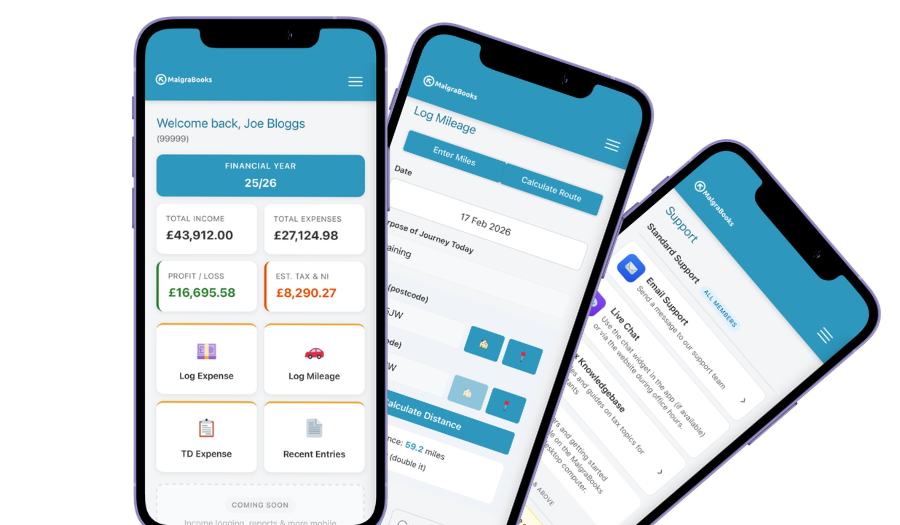
Access your accounts on your mobile
Designed for iPhone and Android phones, so you can add a payment, log a journey or scan a receipt between jobs, and check your reports and tax as you go.
See the mobile appHow Pulse helps
Pulse is our online bookkeeping system, with apps for iPhone and Android. Here’s what electricians use most.
Quotes that become invoices
Send a quote for a consumer unit change or a rewire. When the customer says yes, turn it into an invoice in one click, with the labour and materials already on it.
QuotesDeposits and card payments
Add your Stripe, SumUp or PayPal.Me link and a Pay online button appears on your invoices. The money goes straight to you, and if a customer pays a deposit first, Pulse tracks the part payment and what’s left.
Online paymentsRegular work on repeat
Do regular checks for a letting agent or a local shop for a fixed fee? Set the invoice up once and Pulse creates it every month, quarter or year. Send it automatically or check it first.
Recurring invoicesScan wholesaler receipts
Take a photo of the receipt at the trade counter and it’s saved against the expense, before it ends up in the footwell of the van.
Receipt scannerMileage on your phone
Enter postcodes or use your location, and Pulse works out the miles. Save your wholesaler and the letting agent’s properties in your address book so each journey takes seconds.
Logging mileageStraight to HMRC
Pulse is recognised by HMRC for Making Tax Digital. Send your quarterly updates from Pulse, and your tax return if you choose that package.
Sending MTD updatesEverything in one package
Small Business Complete includes everything on this page. There are no invoice limits, and you can start partway through the year and add the months you've missed.
MalgraBooks is recognised by HMRC for Making Tax Digital. HMRC reference D5P1NR.
Small Business Complete
- Bookkeeping, invoicing and mileage in Pulse
- Unlimited receipt scanning
- Making Tax Digital quarterly updates
- Your tax return sent to HMRC
Questions electricians ask us
I also do some work for builders under CIS. Is that different?
Yes. When you work for a contractor under the Construction Industry Scheme, they take money off the labour on your invoice and pass it to HMRC, and you claim it back through your tax return. Your domestic jobs don’t have that. Our page for CIS subcontractors explains how it works.
Do the materials I charge for count towards the Making Tax Digital threshold?
Yes. Your turnover is everything you charge customers, materials included, before any expenses. For electricians that often makes a real difference, so check your full turnover rather than your labour alone. When do I need to start?
A customer bought their own EV charger and I fitted it. What do I record?
Just what you charged for fitting it. You didn’t buy the charger, so there’s no expense to claim and it isn’t part of your income. If you’d bought it and put it on your invoice, the whole invoice would be your income and the charger would be your expense.
Do I need to register for VAT?
Only if your turnover goes over £90,000 in any rolling 12 months. Remember that includes the materials you charge for, so keep an eye on it if you do a lot of consumer units, rewires or EV chargers. VAT explained
Do I need to register as self-employed?
If you earn more than £1,000 a year from your own electrical work before expenses, yes. You need to register by 5 October after the end of the tax year you started in. For example, if you started in June 2026, that’s by 5 October 2027. How to register with HMRC
How long do I need to keep my records?
At least five years after the 31 January deadline for that tax year. Records and receipt photos in Pulse count, so you don’t need to keep the paper wholesaler receipts as well. Keeping records
Got a question that isn't here? Send us a message and the team will get back to you.