
Bookkeeping and Making Tax Digital (MTD) for Etsy sellers
You make it at the kitchen table, photograph it by the window and post it the next morning. Then Etsy pays out what’s left after its fees, and that’s where the bookkeeping gets confusing. Pulse keeps your sales, fees, supplies and post office trips in one place, ready for Making Tax Digital.
- Record your full sales, not just what Etsy pays out
- Scan receipts for supplies and packaging on your phone
- Send your quarterly updates and tax return straight to HMRC
Lucy’s Monday
Handmade silver jewellery-
Packs the weekend’s orders8:30am
-
Hoop earrings, to Sarah in Leeds£28 plus £3 postage£31
-
Birthstone necklace, to Gareth in Swansea£42 plus £3 postage£45
-
Three stacking rings, to Fiona in Norwich£54 plus £3 postage£57
-
Post Office, Market StreetThree parcels sent, £9.60 postage paid1.5 miles from home
-
Craft supplier, Riverside Trade ParkSilver wire and jump rings, £36, receipt scanned6.0 miles
-
Back home to make new stock12:30pm5.5 miles
When Making Tax Digital starts for you
Making Tax Digital for Income Tax means keeping your records digitally and sending HMRC a short update every three months, then a final declaration after the tax year ends. Whether you're in depends on your turnover, the total you charge your customers before any expenses, not your profit.
- From 6 April 2026Over £50,000Already started
- From 6 April 2027Over £30,000Based on your 2025/26 tax return
- From 6 April 2028Over £20,000Based on your 2026/27 tax return
An example. You send 80 orders a month at £25 each, including postage. That’s 12 × £2,000, or £24,000 of turnover. Etsy’s fees mean less than that reaches your bank, but it’s the £24,000 that counts. If your 2026/27 tax return shows that, you’ll need to use Making Tax Digital from 6 April 2028.
The quarterly updates are due by 7 August, 7 November, 7 February and 7 May. If you have other self-employed work or rent out a property, that income counts towards the total too. When do I need to start?
What counts as your income on Etsy
This is the one Etsy sellers most often get wrong. Etsy takes its fees before it pays you, so it’s tempting to treat the money that lands in your bank as your income. It isn’t.
Your income, or turnover, is the full price your buyers paid, plus the postage they paid you. Etsy’s fees are an expense. That includes listing fees, transaction fees, payment processing fees, Etsy Ads and any Offsite Ads fees.
Your profit comes out the same either way, so why does it matter? Because HMRC’s guidance for Making Tax Digital says to record the full income and the costs separately. And the turnover limits that decide when Making Tax Digital starts for you are based on that full figure, not your payouts.
How to put it in Pulse
Pulse doesn’t link to Etsy or to your bank, so you add the figures yourself. It only takes a minute or two.
Sales. Add each order as income, including the postage, or one total for each day’s sales.
Fees. Etsy puts a monthly statement in your payment account at the start of each month. Add the fees from it as an expense.
Your own costs. Postage, packaging and supplies go in as expenses when you pay for them.
Read more about stock and materials and marketing and subscriptions.
| Your month | Amount |
|---|---|
| Item sales | £1,000 |
| Postage charged to buyers | £100 |
| Turnover, recorded as income | £1,100 |
| Etsy fees, recorded as an expense | £150 |
| Payout to your bank | £950 |
£1,100 of turnover less £150 of fees leaves the £950 Etsy pays you. Your postage, packaging and supplies then come off as expenses too.
Etsy tells HMRC what you sell
Since 1 January 2024, sites like Etsy have had to collect their sellers’ details and report what they’ve earned to HMRC each year, by the following January. They also have to give you a copy of what they send.
You’re left out only if you make fewer than 30 sales of goods in a calendar year and receive less than 2,000 euros (about £1,700) for them. Go over either and you’ll be reported.
Being reported doesn’t automatically mean you owe tax. But if you’re making things to sell and your sales come to more than the £1,000 trading allowance in a tax year, you need to tell HMRC anyway.
From GOV.UK: Selling goods or services on a digital platform
What you can claim as an Etsy seller
Every allowable expense brings down the profit you pay tax and National Insurance on. These are the ones Etsy sellers claim most. Keep the receipt for each, or scan it into Pulse.
Materials and packaging
Silver wire, beads, wax, wicks, yarn, card and ink, plus boxes, mailing bags, tissue paper and thank-you cards. Stock and materials
Postage
What you pay to send orders out, including replacements for anything lost in the post. The postage your buyer paid you is income.
Etsy fees
Listing, transaction and payment processing fees, Etsy Ads and Offsite Ads. You’ll find them on your monthly statement.
Equipment and tools
A cutting machine, kiln, printer, heat press or jewellery tools. Bigger items may need to go in as a capital allowance.
Photography kit
A light box, backdrops and props for your listing photos, and a camera if you buy one for the business. Office and equipment
Working from home
If you spend 25 hours or more a month making, packing or doing admin at home, you can claim a flat rate of £10 to £26 a month. Simplified expenses
Training
Courses that improve skills you already use, like a silversmith learning stone setting. A course to start a different business usually isn’t claimable. Training costs
Marketing and subscriptions
Your own website, Etsy Plus, design software, business cards and social media ads. Marketing costs
What you can’t claim
- Your own time. You can’t pay yourself an hourly rate as an expense
- The personal share of your phone, broadband or printer
- Materials for things you make for yourself, or give to friends and family
For the full list, see Allowable expenses, what are they?
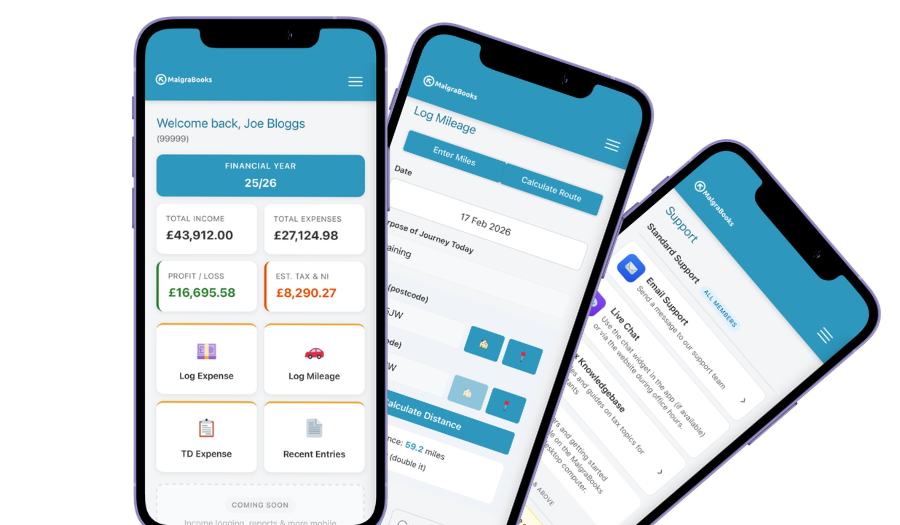
Access your accounts on your mobile
Designed for iPhone and Android phones, so you can add a payment, log a journey or scan a receipt between jobs, and check your reports and tax as you go.
See the mobile appHow Pulse helps
Pulse is our online bookkeeping system, with apps for iPhone and Android. Here’s what Etsy sellers use most.
Scan your receipts
Beads, wire, mailing bags and stamps add up fast. Take a photo of each receipt in the app and it’s saved against the expense, so nothing gets lost in the craft drawer.
Receipt scannerSimple income records
Add each order or each day’s sales, including postage, in a few taps. Your full turnover builds up as you go, which is the figure that decides when Making Tax Digital applies to you.
When MTD starts for youRegular costs remembered
Etsy Plus, your website and your design software come round every month. Add them as recurring expenses and Pulse asks you to confirm each one when it’s due.
Recurring expensesMileage on your phone
Enter postcodes or use your location, and Pulse works out the miles. Save the post office and your suppliers in your address book so each trip takes seconds.
Logging mileageHours at home
Record the hours you spend making, packing and doing admin at home, and Pulse gives you the working from home allowance for each month.
Working from homeStraight to HMRC
Pulse is recognised by HMRC for Making Tax Digital. Send your quarterly updates from Pulse, and your tax return if you choose that package.
Sending MTD updatesEverything in one package
Small Business Complete includes everything on this page. There are no invoice limits, and you can start partway through the year and add the months you've missed.
MalgraBooks is recognised by HMRC for Making Tax Digital. HMRC reference D5P1NR.
Small Business Complete
- Bookkeeping, invoicing and mileage in Pulse
- Unlimited receipt scanning
- Making Tax Digital quarterly updates
- Your tax return sent to HMRC
Questions Etsy sellers ask us
It started as a hobby. Do I need to register as self-employed?
If you make things to sell, HMRC is likely to see it as trading, even if it began as a hobby. If your sales, including the postage buyers pay you, come to more than £1,000 in a tax year before expenses, you need to tell HMRC. Register by 5 October after the end of the tax year you started in. For example, if you started in June 2026, that’s by 5 October 2027. How to register with HMRC
I also sell at craft fairs and on my own website. Does that go in too?
Yes. If you’re selling the same things, it’s all one business, so every sale goes in Pulse together, wherever it was made. Your pitch fees and card machine fees are expenses too. Card payment charges
I buy supplies for things I won’t sell for months. When do I claim them?
The cash basis is HMRC’s standard way for sole traders. You record an expense when you pay for it, so silver bought in March goes in March, even if the ring sells in May. If you hold a lot of stock, ask us whether another way suits you better.
I’ve just bought a cutting machine. Can I claim it this year?
Usually, yes. Equipment you buy for the business can normally be claimed in full in the tax year you buy it, either as an expense or as a capital allowance. If you also use it for personal projects, you can only claim the business share. Capital allowances
Do I need to register for VAT?
Only if your turnover, including postage charged, goes over £90,000 in any rolling 12 months. Most Etsy sellers are well under this. Etsy adds VAT to its fees for UK sellers, so if you’re not VAT registered, claim the fees including the VAT. VAT explained
How long do I need to keep my records?
At least five years after the 31 January deadline for that tax year. Records and receipt photos in Pulse count, so you don’t need to keep paper copies as well. It’s worth saving your Etsy monthly statements too. Keeping records
Got a question that isn't here? Send us a message and the team will get back to you.