
Bookkeeping and Making Tax Digital (MTD) for self-employed gardeners
You spend the day mowing lawns, cutting hedges and clearing borders, and the invoices wait until it’s too dark to work. Pulse keeps it all in one place, from your quotes and regular clients to the miles between gardens and your Making Tax Digital updates.
- Turn an accepted quote into an invoice in one click
- Invoice your regular gardens every fortnight automatically
- Send your quarterly updates and tax return straight to HMRC
Dan’s Thursday
£25 an hour-
Leaves home8:00am
-
Mr and Mrs Patel, Hollins Lane3 hours mowing and edging, on a fortnightly invoice£754.5 miles from home
-
Laurel hedge, Church RoadOne-off job, quote turned into an invoice£1803.5 miles
-
Green waste sitePaid £12 to tip the hedge cuttings, receipt scanned2.0 miles
-
Hillside Court, communal gardens2 hours, on a fortnightly invoice to the managing agent£503.0 miles
-
Back home5:30pm5.0 miles
When Making Tax Digital starts for you
Making Tax Digital for Income Tax means keeping your records digitally and sending HMRC a short update every three months, then a final declaration after the tax year ends. Whether you're in depends on your turnover, the total you charge your customers before any expenses, not your profit.
- From 6 April 2026Over £50,000Already started
- From 6 April 2027Over £30,000Based on your 2025/26 tax return
- From 6 April 2028Over £20,000Based on your 2026/27 tax return
An example. Your regular gardens bring in £2,000 a month from March to October and £750 a month over the four winter months. One-off jobs from quotes add £6,000. That’s £16,000 plus £3,000 plus £6,000, or £25,000 of turnover. It’s under £30,000 but over £20,000, so if your 2026/27 tax return shows that, you’ll need to use Making Tax Digital from 6 April 2028.
The quarterly updates are due by 7 August, 7 November, 7 February and 7 May. If you have other self-employed work or rent out a property, that income counts towards the total too. When do I need to start?
Busy summers, quiet winters
This is where gardeners most often get caught out. Most of your money comes in between spring and autumn, but your tax bill is due on 31 January, right in the quietest part of the year. If nothing’s been put aside, January can hurt.
It helps to think of your work in two parts. Regular mowing and tidying suits a recurring invoice, set up once at whatever gap you visit, fortnightly in summer or every four weeks in winter. Bigger jobs, like a hedge cut or a border clear-out, start as a quote. When the client says yes, the quote becomes the invoice, so nothing gets typed twice.
The simplest habit is to move a share of every payment into a separate savings account through the busy months. That covers the quiet weeks and the January bill. Your first bill can be bigger than you expect because of payments on account.
Driving between gardens. If you run the business from home and travel out to different clients, the drive from home to your first garden, between gardens and back home again is usually business travel. You claim a flat rate per mile, which covers the van’s fuel, insurance and servicing. If you work at the same site every day, for example one estate, that can look more like ordinary commuting, so ask us before you claim it.
Read more about cars, vans and mileage and tax return deadlines.
| Where the money comes from | Turnover |
|---|---|
| Regular gardens, March to October | £16,000 |
| Regular gardens, November to February | £3,000 |
| One-off jobs from quotes | £6,000 |
| Total for the year | £25,000 |
In this example, £16,000 of the £19,000 from regular gardens comes in between March and October. The balancing payment for your tax is always due on 31 January.
| Car or van | Per mile |
|---|---|
| First 10,000 business miles | 55p |
| Every mile after that | 25p |
If you claim mileage for your van, you can’t also claim its fuel or running costs. Once you’ve used the mileage rate for a vehicle, you keep using it for as long as you use that vehicle for work.
What you can claim as a gardener
Every allowable expense brings down the profit you pay tax and National Insurance on. These are the ones gardeners claim most. Keep the receipt for each, or scan it into Pulse.
Tools and equipment
Mowers, strimmers, hedge trimmers, leaf blowers and hand tools, plus servicing and blade sharpening. Bigger items may need to go in as a capital allowance.
Fuel for your tools
Petrol and two-stroke oil for the mower, strimmer and blower. This is separate from your van, so you can claim it even if you use the mileage rate.
Green waste tip fees
What you pay to tip clients’ grass cuttings, hedge trimmings and branches at a site that takes waste from businesses.
Training
Courses that build on the work you already do, such as hedge laying or using a chainsaw safely. Training costs
Protective clothing
Safety boots, gloves, ear defenders, eye protection and chainsaw trousers. Everyday clothes don’t count. Clothing expenses
Insurance
Public liability insurance, and cover for the tools and equipment you carry in the van.
Plants and materials
Plants, compost, bark and seed you buy for a client’s garden. What you charge them for it is part of your income.
Phone and adverts
The business share of your mobile, plus leaflets, a local Facebook ad or a simple website. Marketing costs
What you can’t claim
- Fuel for your van if you claim mileage for it
- Everyday clothes, even old ones you keep just for gardening
- Plants a client buys themselves for you to put in
- Parking and speeding fines
For the full list, see Allowable expenses, what are they?
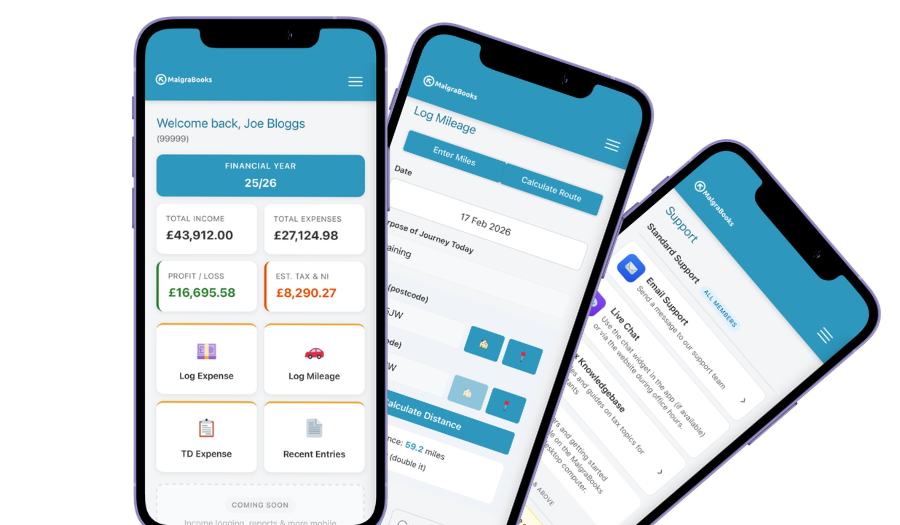
Access your accounts on your mobile
Designed for iPhone and Android phones, so you can add a payment, log a journey or scan a receipt between jobs, and check your reports and tax as you go.
See the mobile appHow Pulse helps
Pulse is our online bookkeeping system, with apps for iPhone and Android. Here’s what gardeners use most.
Quotes into invoices
Send a quote for a hedge cut or a garden clear-out. When the client says yes, turn it into an invoice in one click.
QuotesRecurring invoices
Set up a regular garden once and Pulse creates the invoice every week, fortnight, four weeks or month. Send it automatically or check it first.
Recurring invoicesMileage on your phone
Enter postcodes or use your location, and Pulse works out the miles. Save your regular gardens and the tip in your address book so each journey takes seconds.
Logging mileageScan your receipts
Take a photo of a tip receipt or a fuel can receipt in the app and it’s saved against the expense, so nothing gets lost in the van.
Receipt scannerGet paid by card
Add your Stripe, SumUp or PayPal.Me link and a Pay online button appears on your invoices. The money goes straight to you, and part payments are tracked.
Online paymentsStraight to HMRC
Pulse is recognised by HMRC for Making Tax Digital. Send your quarterly updates from Pulse, and your tax return if you choose that package.
Sending MTD updatesEverything in one package
Small Business Complete includes everything on this page. There are no invoice limits, and you can start partway through the year and add the months you've missed.
MalgraBooks is recognised by HMRC for Making Tax Digital. HMRC reference D5P1NR.
Small Business Complete
- Bookkeeping, invoicing and mileage in Pulse
- Unlimited receipt scanning
- Making Tax Digital quarterly updates
- Your tax return sent to HMRC
Questions gardeners ask us
Do I need to register as self-employed?
If you earn more than £1,000 a year from gardening before expenses, yes. You need to register by 5 October after the end of the tax year you started in. For example, if you started in June 2026, that’s by 5 October 2027. How to register with HMRC
How much should I put aside for winter and my tax bill?
There’s no single figure, because it depends on your profit. What matters is the habit. Move a share of each payment into a separate account through the busy months, and remember that your tax bill on 31 January may include a payment on account towards next year as well.
I buy plants for a client and add them to the bill. How do I record that?
The whole invoice is your income, and the plants are your expense. If the client buys the plants themselves and you just put them in, there’s nothing for you to record except your own charge.
I claim mileage for my van. Can I still claim fuel for the mower?
Yes. The mileage rate covers the van’s fuel and running costs, so you can’t claim those. Petrol and oil for your mower, strimmer and other tools are a separate expense and you can claim them as well.
Do I need to register for VAT?
Only if your turnover goes over £90,000 in any rolling 12 months. Most self-employed gardeners are well under this. VAT explained
Got a question that isn't here? Send us a message and the team will get back to you.