
Bookkeeping and Making Tax Digital (MTD) for self-employed Juice Plus partners
A coffee with a customer, a team call over lunch, a training evening and an earnings statement to check. Lots of partners fit this around a job or a family, and the bookkeeping is easy to leave until January. Pulse keeps your income, costs, miles and Making Tax Digital updates in one place.
- Add each earnings statement as income in a minute
- Log the miles to customers, events and training
- Send your quarterly updates and tax return straight to HMRC
Karen’s Thursday
Day off from her job-
Leaves home9:30am
-
Coffee with Gillian, Bridge StreetCatch-up with a customer. The miles count, the coffees don’t2.5 miles from home
-
Printers, Mill LanePicks up 250 business cards, £20, receipt scanned1.5 miles
-
Back homeOnline team call, 1 hour, added to her working from home hours3.0 miles
-
Earnings statementSeptember’s commission, paid into her bank£200
-
Team training evening, Station Road£15 ticket, receipt scanned6.0 miles
-
Back home9:30pm6.0 miles
When Making Tax Digital starts for you
Making Tax Digital for Income Tax means keeping your records digitally and sending HMRC a short update every three months, then a final declaration after the tax year ends. Whether you're in depends on your turnover, the total you charge your customers before any expenses, not your profit.
- From 6 April 2026Over £50,000Already started
- From 6 April 2027Over £30,000Based on your 2025/26 tax return
- From 6 April 2028Over £20,000Based on your 2026/27 tax return
An example. You work three days a week in a school office. Your earnings statements come to £600 a month, which is £7,200 a year, and you rent out a flat for £1,100 a month, which is £13,200 a year. Your school wages don’t count, but the rent does, so your qualifying income is £20,400. That’s over £20,000, so if your 2026/27 tax return shows that, you’ll need to use Making Tax Digital from 6 April 2028. Without the flat, £7,200 on its own wouldn’t bring you in yet, but you’d still need a tax return.
The quarterly updates are due by 7 August, 7 November, 7 February and 7 May. If you have other self-employed work or rent out a property, that income counts towards the total too. When do I need to start?
Commission, your own products and events
Most of the questions partners ask us come down to three things: what counts as income, whether the products you use yourself are a business cost, and what you can claim for events and training.
What the company pays you. Everything the company pays you for your business is income, whether your statement calls it commission, a bonus or something else. Record the full amount shown on the statement. If anything is taken off before it reaches your bank, the full amount is still your income, and a business fee taken off can go in as an expense. If you ever buy products and sell them on yourself, the sale is income and what you paid is an expense.
Products you use yourself. These are personal, even if you order them through your business. HMRC doesn’t allow goods bought for private use. Products you give away as free samples to advertise your business are different, and can usually be claimed because they’re things you sell.
Events, training and travel. A ticket for a training day that helps with the business you already run can be claimed, and so can the travel there. On an overnight trip, the hotel and your meals count too. Extra nights for a break, or someone coming along for company, don’t. Coffees and meals for customers or guests don’t count either, because HMRC treats them as entertaining.
A job as well. You can be employed and self-employed at the same time. Your wages are taxed through PAYE as usual, and your partner income goes on a Self Assessment tax return. If it’s not clear where something fits, ask us.
Read more about conferences and training, stock and goods for resale and allowable expenses.
| Cost | Claim it? |
|---|---|
| Products you use yourself | No |
| Products given away as free samples | Usually yes |
| Ticket for a training day | Yes |
| Hotel and meals on an overnight training trip | Yes |
| Extra nights to make a break of it | No |
| Coffee or lunch with a customer | No |
| Miles to customers, events and training | Yes, 55p a mile |
The 55p rate is for a car or van, for the first 10,000 business miles in 2026/27, then 25p. If you claim mileage, you can’t also claim fuel for that car. Cars, vans and mileage
| Before any costs | What it means |
|---|---|
| £1,000 or less | Usually nothing to tell HMRC |
| Over £1,000 | Register by 5 October after the tax year |
| Over £20,000 | Making Tax Digital from 6 April 2028 |
| Over £30,000 | Making Tax Digital from 6 April 2027 |
The £1,000 covers all your self-employed income added together. The April 2027 date is based on your 2025/26 tax return and the April 2028 date on your 2026/27 return. Rental income is added in for Making Tax Digital, wages aren’t.
What you can claim as a Juice Plus partner
Every allowable expense brings down the profit you pay tax and National Insurance on. These are the ones partners claim most. Keep the receipt for each, or scan it into Pulse.
Free samples
Products you give away to advertise your business, as long as they’re things you sell. Not the products you use at home. Stock and goods for resale
Business fees
Fees your company charges you for running your business, such as a website or renewal fee if you pay one. If a fee includes products for you, ask us how to split it.
Training and events
Tickets for training days and events that help with the business you already run. Conferences and training
Travel and mileage
Miles to customers, team meetings and training, plus train fares, parking, and the hotel and meals on an overnight business trip. Cars, vans and mileage
Room hire
A room you hire to run a business presentation or meet customers. Food and drink you lay on for guests usually can’t be claimed. Renting a chair, room or pitch
Phone and broadband
The business share of your mobile and internet, which is where a lot of your customer messages and team calls happen. Phone and broadband
Marketing
Business cards, flyers, paid social media posts or a simple website of your own. Marketing costs
Admin at home
If you spend 25 hours or more a month on calls, messages and admin at home, you can claim a flat rate of £10 to £26 a month. Simplified expenses
What you can’t claim
- Products for you or your family, even if you order them through your business
- Coffees, meals and drinks for customers or guests
- The leisure part of a trip, like extra nights or someone coming along
- Outfits for events, even if you only wear them for work
- Fuel for your car if you claim mileage for it
- Your actual costs, if you’ve taken off the £1,000 trading allowance instead
For the full list, see Allowable expenses, what are they?
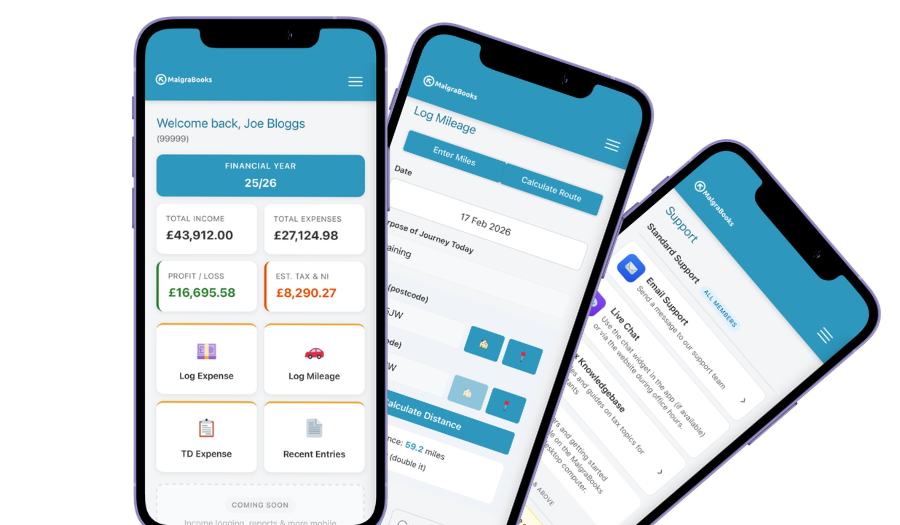
Access your accounts on your mobile
Designed for iPhone and Android phones, so you can add a payment, log a journey or scan a receipt between jobs, and check your reports and tax as you go.
See the mobile appHow Pulse helps
Pulse is our online bookkeeping system, with apps for iPhone and Android. Here’s what partners use most.
Your statements as income
When a statement is paid, add the full amount as income with the date it was paid. Keep the statement itself with your records, and each month’s figure is ready for your quarterly update.
Keeping recordsScan your receipts
Take a photo of the receipt for an event ticket, a train fare or a box of business cards and it’s saved against the expense, so nothing gets lost in your handbag.
Receipt scannerMileage on your phone
Enter postcodes or use your location, and Pulse works out the miles. Save the café you meet customers in and your usual training venue in the Address Book so each journey takes seconds.
Logging mileageWorking from home
Log the hours you spend on team calls, customer messages and admin at home. Once you reach 25 hours in a month, you can claim the flat-rate allowance.
Working from homeRegular costs remembered
Your phone contract and any monthly business fee come round like clockwork. Add them as recurring expenses and Pulse asks you to confirm each one when it’s due.
Recurring expensesStraight to HMRC
Pulse is recognised by HMRC for Making Tax Digital. Send your quarterly updates from Pulse, and your tax return if you choose that package.
Sending MTD updatesEverything in one package
Small Business Complete includes everything on this page. There are no invoice limits, and you can start partway through the year and add the months you've missed.
MalgraBooks is recognised by HMRC for Making Tax Digital. HMRC reference D5P1NR.
Small Business Complete
- Bookkeeping, invoicing and mileage in Pulse
- Unlimited receipt scanning
- Making Tax Digital quarterly updates
- Your tax return sent to HMRC
Questions Juice Plus partners ask us
I’ve got a job as well. Do I need to register as self-employed?
If your partner income is more than £1,000 in a tax year before any costs, yes, even with a job. You need to register by 5 October after the end of the tax year you started in. For example, if you started in June 2026, that’s by 5 October 2027. How to register with HMRC
Does my salary count towards Making Tax Digital?
No. Only your self-employed income and any rental income count. Your wages still count when your tax bill is worked out, but they don’t decide whether you need to use Making Tax Digital.
Can I claim the products I order for myself?
No. Products you use yourself, or share with your family, are personal, even if you order them through your business. Products you give away as free samples to advertise your business can usually be claimed. Keep a note of who had them and when.
Can I claim the cost of a company event or training day?
Usually, if it helps with the business you already run. The ticket, the travel and, on an overnight trip, the hotel and your meals can all go in. Extra nights or anything done for fun can’t. If the company pays for the trip, or it’s a reward you’ve earned, ask us how to record it. Conferences and training
Do I need to register for VAT?
Only if your own turnover goes over £90,000 in any rolling 12 months. That’s what the company pays you, plus any other self-employed income. VAT explained
How long do I need to keep my statements and receipts?
At least five years after the 31 January deadline for that tax year. Receipt photos in Pulse count, so you don’t need to keep the paper copies as well. Keeping records
Got a question that isn't here? Send us a message and the team will get back to you.
Juice Plus is a trade mark of its owner. MalgraBooks isn’t connected with Juice Plus.