
Bookkeeping and Making Tax Digital (MTD) for self-employed tutors and music teachers
Lessons after school at your kitchen table, a drive across town to a pupil’s house, then a video lesson after tea. Parents pay by the term, by the lesson, by bank transfer or through a tutoring website. Pulse keeps it all in one place, from your teaching room to your Making Tax Digital updates.
- Invoice families by the term, the month or the lesson
- Log the hours you teach at home and the miles to pupils’ houses
- Send your quarterly updates and tax return straight to HMRC
Priya’s Tuesday
£40 an hour-
Starts at home4:00pm
-
Tom, theory lesson by video call30 minutes, paid online by card£20
-
Ella, piano in the teaching room45 minutes, on a termly invoice£30
-
Ruby, piano at her house on Park Lane1 hour, paid by bank transfer£403.5 miles from home
-
Back home6:45pm3.5 miles
When Making Tax Digital starts for you
Making Tax Digital for Income Tax means keeping your records digitally and sending HMRC a short update every three months, then a final declaration after the tax year ends. Whether you're in depends on your turnover, the total you charge your customers before any expenses, not your profit.
- From 6 April 2026Over £50,000Already started
- From 6 April 2027Over £30,000Based on your 2025/26 tax return
- From 6 April 2028Over £20,000Based on your 2026/27 tax return
An example. You teach 20 hours a week at £30 an hour, for 40 weeks a year. That’s 40 × £600, or £24,000 of turnover. If your 2026/27 tax return shows that, you’ll need to use Making Tax Digital from 6 April 2028.
The quarterly updates are due by 7 August, 7 November, 7 February and 7 May. If you have other self-employed work or rent out a property, that income counts towards the total too. When do I need to start?
Teaching from home
This is the one tutors and music teachers ask us about most. If pupils come to you, or you teach online from home, you can claim part of what it costs to run your home. There are two ways to do it, and you pick one.
The flat rate. Add up the hours you work at home each month, including lessons, preparation and admin. If it’s 25 hours or more, claim £10, £18 or £26 for that month. There are no bills to dig out.
Your actual costs. Work out the business share of your heating, electricity, council tax, and mortgage interest or rent. You split them by the rooms you use and the time you use them for.
An example. Priya’s home has five rooms and she uses one of them only for teaching. Her heating, electricity and council tax come to £3,000 a year, so the teaching room’s share is £600. She works about 80 hours a month at home, so the flat rate would be £18 a month, or £216 a year. Working it out gives Priya the bigger claim, but she has to keep the bills and show how she got there.
If your teaching room is the family sitting room in the evening, cut the claim down to the share of time it’s used for work. A room used only for business can also affect tax when you sell your home, so ask us before you claim that way.
Travelling to pupils. If you teach from home and drive out to pupils’ houses, those journeys are usually business travel, there and back. If you teach at the same school or music centre every week, that can look more like commuting, which you can’t claim. If that sounds like you, ask us first.
Read more about simplified expenses, office, property and equipment, cars, vans and mileage and parking charges.
| Hours worked at home | Per month |
|---|---|
| 25 to 50 hours | £10 |
| 51 to 100 hours | £18 |
| 101 hours or more | £26 |
The flat rate doesn’t include your phone or broadband. Claim the business share of those separately, whichever way you choose.
Driving to pupils is 55p a mile for the first 10,000 business miles in 2026/27, then 25p. If you claim mileage for a car, you can’t also claim its fuel or running costs.
What you can claim as a tutor or music teacher
Every allowable expense brings down the profit you pay tax and National Insurance on. These are the ones tutors and music teachers claim most. Keep the receipt for each, or scan it into Pulse.
Books and resources
Textbooks, past papers, sheet music, printing, stationery and stickers for your younger pupils.
Instruments and equipment
Repairs, tuning, strings, reeds and music stands. Bigger items like a keyboard or laptop may need to go in as a capital allowance.
Online subscriptions
Your video call tool, online whiteboard and resource websites. Subscriptions
Platform and agency fees
The commission or fees a tutoring website or agency takes for finding you pupils.
DBS checks
The cost of your DBS check, and the DBS Update Service if you use it to keep your certificate up to date.
Training
Courses that keep your teaching skills up to date. Conferences and training
Insurance
Public liability insurance, professional indemnity and cover for the instruments you teach with.
Phone and broadband
The business share of your mobile and internet, which matters if you teach online. Phone and broadband
What you can’t claim
- Everyday clothes, even smart ones you only wear to teach
- Parking and speeding fines
- The personal share of your household bills, phone or instrument
- Courses that start you in a new line of work, rather than keep your teaching up to date
For the full list, see Allowable expenses, what are they?
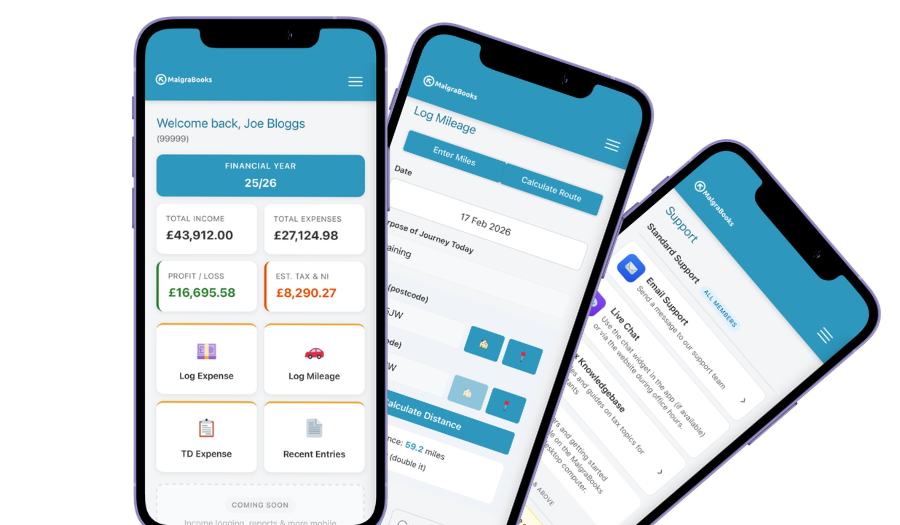
Access your accounts on your mobile
Designed for iPhone and Android phones, so you can add a payment, log a journey or scan a receipt between jobs, and check your reports and tax as you go.
See the mobile appHow Pulse helps
Pulse is our online bookkeeping system, with apps for iPhone and Android. Here’s what tutors and music teachers use most.
Invoices for families
Send one invoice for a term’s lessons, or set up a family once and Pulse creates their invoice every week, four weeks, month or quarter. Send it automatically or check it first.
Recurring invoicesGet paid online
Add your Stripe, SumUp or PayPal.Me link and a Pay online button appears on your invoices. The money goes straight to you, and if parents pay a term in instalments, the part payments are tracked.
Online paymentsWorking from home hours
Log the hours you teach and prepare at home, and Pulse works out your flat rate allowance for each month.
Working from homeMileage on your phone
Enter postcodes or use your location, and Pulse works out the miles. Save your regular pupils in your address book so each journey takes seconds.
Logging mileageRegular costs remembered
Your video call subscription and insurance come round every month. Add them as recurring expenses and Pulse asks you to confirm each one when it’s due.
Recurring expensesStraight to HMRC
Pulse is recognised by HMRC for Making Tax Digital. Send your quarterly updates from Pulse, and your tax return if you choose that package.
Sending MTD updatesEverything in one package
Small Business Complete includes everything on this page. There are no invoice limits, and you can start partway through the year and add the months you've missed.
MalgraBooks is recognised by HMRC for Making Tax Digital. HMRC reference D5P1NR.
Small Business Complete
- Bookkeeping, invoicing and mileage in Pulse
- Unlimited receipt scanning
- Making Tax Digital quarterly updates
- Your tax return sent to HMRC
Questions tutors and music teachers ask us
I get pupils through a tutoring website or agency. Is that self-employed income?
Usually, yes. If the website or agency pays you without taking off tax, that money is part of your self-employed income and goes in your records alongside your private pupils. The exception is an agency that takes tax off through PAYE and gives you payslips. That’s employment income, so it goes on your tax return separately. If you’re not sure which you have, ask us.
The tutoring website takes its fee before it pays me. What do I record?
Go by your statement. If it shows the full lesson fee with the website’s commission taken off, record the full fee as income and the commission as an expense. Your profit comes out the same, and your turnover is right for Making Tax Digital.
Parents pay for the whole term up front. When does it count as income?
Most sole traders use the cash basis, where income counts when you receive it. So if a parent pays for the summer term in late March, it goes in the tax year ending 5 April, even though the lessons come later.
I pay exam entry fees for my pupils. How do I record them?
If you pay the fee and add it to the parent’s invoice, the whole invoice is your income and the exam fee is your expense. If parents pay the exam board themselves, there’s nothing for you to record.
Do I need to charge VAT on lessons?
Usually not. Private tuition from a sole trader is exempt from VAT when the subject is taught regularly in schools or universities. It’s different if you bring in other tutors or sell books and other items, so ask us if that’s you. VAT explained
Do I need to register as self-employed?
If you earn more than £1,000 a year from teaching before expenses, yes. You need to register by 5 October after the end of the tax year you started in. For example, if you started in September 2026, that’s by 5 October 2027. How to register with HMRC
Got a question that isn't here? Send us a message and the team will get back to you.