
Bookkeeping and Making Tax Digital (MTD) for self-employed window cleaners
Pole up by eight, a street of houses done by lunch and the shop fronts on the parade after that. Most of your customers want doing every four weeks. Some pay cash on the door, some pay online and a few are never in when you knock. Pulse sends the regular invoices for you, keeps track of who’s paid and gets your Making Tax Digital updates to HMRC.
- Repeat invoices every four weeks without typing them again
- Add a Pay online button and see who still owes you
- Send your quarterly updates and tax return straight to HMRC
Craig’s Thursday
Week 2 of a 4-week round-
Leaves home7:45am, tank full of pure water
-
Ashworth Drive12 houses at £15. Eight pay cash on the door, four are on 4-weekly invoices£1803.4 miles from home
-
Larch Close10 houses at £12, all on 4-weekly invoices with a Pay online button£1200.6 miles
-
Newsagent, Moor Lane paradeShop front inside and out, on a monthly invoice£250.9 miles
-
Mrs Bell, Fern WayWindows £18 and the conservatory roof £40, paid in cash£580.5 miles
-
Back home3:00pm3.6 miles
When Making Tax Digital starts for you
Making Tax Digital for Income Tax means keeping your records digitally and sending HMRC a short update every three months, then a final declaration after the tax year ends. Whether you're in depends on your turnover, the total you charge your customers before any expenses, not your profit.
- From 6 April 2026Over £50,000Already started
- From 6 April 2027Over £30,000Based on your 2025/26 tax return
- From 6 April 2028Over £20,000Based on your 2026/27 tax return
An example. You have 160 houses on a 4-weekly round at an average of £15 each, plus four shops paying £25 a month. Every four weeks means 13 rounds a year, not 12, so the houses bring in 13 × £2,400, or £31,200. The shops add £1,200, making £32,400 of turnover. If your 2025/26 tax return shows that, you’ll need to use Making Tax Digital from 6 April 2027.
The quarterly updates are due by 7 August, 7 November, 7 February and 7 May. If you have other self-employed work or rent out a property, that income counts towards the total too. When do I need to start?
Cash on the door or a regular invoice?
Knocking for cash is how most rounds start. It works until the round grows. Then you’re going back on a Saturday for the ones who were out, keeping a notebook of who owes for which clean, and finding fivers and tenners in every jacket pocket.
Regular invoices. In Pulse you set each customer up once and choose how often they’re cleaned. Pulse then creates their invoice every time and either sends it automatically or saves it as a draft. Drafts are handy when rain puts the round back a few days, because you can send each one once the windows are actually done.
Paying online. Add your Stripe, SumUp or PayPal.Me link and a Pay online button appears on every invoice. The customer pays from their phone, the money goes straight to you, and if someone pays half now and half next time, the part payment is tracked.
Knowing who’s paid. When someone pays cash on the door or by bank transfer, mark their invoice as paid. Anything not marked is still owed, so you know exactly whose door to knock on next round.
Cash still counts. Every payment is income, however it’s paid. Cash on the door needs to go in your records the same as an online payment. The easiest habit is to add it in the app before you drive to the next street.
Read more about recurring invoices, online payments and marking an invoice as paid.
| Repeats | Good for |
|---|---|
| Weekly | Busy shop fronts and cafés |
| Every 2 weeks | Offices and shops on a fortnightly clean |
| Every 4 weeks | Most houses on a round |
| Monthly | Businesses that pay on a monthly account |
| Quarterly | Conservatory roofs and frames |
| Yearly | Gutter clearing |
Every four weeks gives 13 cleans a year, monthly gives 12. If you charge a house £15 every four weeks, that’s £195 a year, not £180. Worth knowing when you work out your turnover.
What you can claim as a window cleaner
Every allowable expense brings down the profit you pay tax and National Insurance on. These are the ones window cleaners claim most. Keep the receipt for each, or scan it into Pulse.
Water-fed pole system
Poles, brushes, hose, pump, battery and the tank in the van. Most sole traders use the cash basis and claim the cost as an expense. If you use traditional accounting it goes in as a capital allowance instead.
Pure water filters and resin
Resin, filter cartridges and membranes you replace as they wear out are everyday running costs. The filter unit itself is equipment, like the pole system.
Ladders and hand kit
Ladders, stand-offs, squeegees, applicators, scrims, buckets and detergent for the traditional cleans.
Your van
Either 55p a mile for the first 10,000 business miles then 25p, or the actual running costs and the cost of the van itself. Once you pick a method for a van you stick with it. Cars, vans and mileage
Insurance
Public liability insurance, and cover for the pole system and kit you keep in the van.
Protective clothing
Waterproofs, non-slip boots, gloves and hi-vis. Everyday clothes don’t count. Clothing expenses
Phone and adverts
The business share of your mobile, plus leaflets through doors on a new estate or a local Facebook ad. Marketing costs
Payment fees
The fees Stripe, SumUp or PayPal take when a customer pays online or by card. Card payment charges
What you can’t claim
- Fuel for your van if you claim mileage for it
- Parking tickets on the estate, or any other fines
- Everyday clothes, even an old coat you only wear on the round
- Money you pay another window cleaner to buy their round, as it isn’t a day-to-day cost (ask us if you’re buying one)
For the full list, see Allowable expenses, what are they?
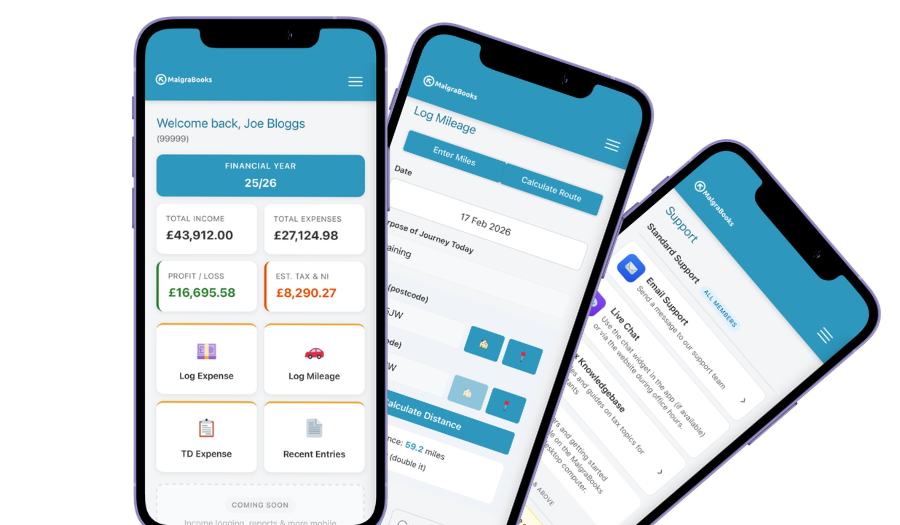
Access your accounts on your mobile
Designed for iPhone and Android phones, so you can add a payment, log a journey or scan a receipt between jobs, and check your reports and tax as you go.
See the mobile appHow Pulse helps
Pulse is our online bookkeeping system, with apps for iPhone and Android. Here’s what window cleaners use most.
Recurring invoices
Set each house or shop up once and choose weekly, every 2 weeks, every 4 weeks, monthly, quarterly or yearly. Pulse sends the invoice automatically, or saves it as a draft for you to check after the clean.
Recurring invoicesPay online button
Add your Stripe, SumUp or PayPal.Me link and customers can pay from the invoice, even when they’re at work. The money goes straight to you, and part payments are tracked.
Online paymentsSee who’s paid
Took cash on the door or spotted a bank transfer? Mark the invoice as paid. Whatever’s left unpaid is your list of doors to knock on next time round.
Marking an invoice as paidMiles between estates
Enter postcodes or use your location, and Pulse works out the miles. Save each estate and the shop parade in the Address Book, so a whole day’s driving takes a minute to log.
Address BookScan your receipts
Photograph the receipt for new resin, a squeegee rubber or a set of brushes in the app and it’s saved against the expense, before it gets wet in the van.
Receipt scannerStraight to HMRC
Pulse is recognised by HMRC for Making Tax Digital. Send your quarterly updates from Pulse, and your tax return if you choose that package.
Sending MTD updatesEverything in one package
Small Business Complete includes everything on this page. There are no invoice limits, and you can start partway through the year and add the months you've missed.
MalgraBooks is recognised by HMRC for Making Tax Digital. HMRC reference D5P1NR.
Small Business Complete
- Bookkeeping, invoicing and mileage in Pulse
- Unlimited receipt scanning
- Making Tax Digital quarterly updates
- Your tax return sent to HMRC
Questions window cleaners ask us
Do I need to register as self-employed?
If you take more than £1,000 a year from window cleaning before any costs, yes. You need to register by 5 October after the end of the tax year you started in. For example, if you started your round in May 2026, that’s by 5 October 2027. How to register with HMRC
Most of my round pays cash. Do I really need to record it all?
Yes. Every payment counts as income, whether it’s cash on the door, a bank transfer or an online payment. If the customer has an invoice in Pulse, mark it as paid. If not, add the cash as income in the app the same day.
Can I claim the drive from home to my round?
Usually, yes. If you run the business from home and go out to different estates and shops, HMRC treats the drive from home to the round, between streets and back again as business travel. If you clean one building every day, like the same office block, that can look more like commuting, so ask us first. Cars, vans and mileage
Should I claim mileage or my van’s actual costs?
A round on a couple of estates often means few miles but a van that costs a lot to run, with a tank and pump fitted. That can make actual costs worth a look. Mileage is simpler, at 55p a mile for the first 10,000 business miles and 25p after. Once you’ve chosen a method for a van you can’t switch, so ask us before you start.
Customers give me a tip at Christmas. Is that income?
Yes. Tips you receive as a self-employed window cleaner are taxable, the same as your normal charges. Add them in Pulse as income when you get them.
Do I need to register for VAT?
Only if your turnover goes over £90,000 in any rolling 12 months. Most self-employed window cleaners are well under this. VAT explained
Got a question that isn't here? Send us a message and the team will get back to you.