
Bookkeeping and Making Tax Digital (MTD) for self-employed counsellors and therapists
A weekly client at ten, a couple at quarter past eleven, supervision after lunch and an online session from the spare room in the evening. Some clients pay by card after the session, some are on a monthly invoice and an agency pays for others. Pulse keeps your fees, room hire and supervision costs in one place and sends your Making Tax Digital updates to HMRC.
- Invoice regular weekly clients automatically
- Keep room hire, supervision and CPD receipts with each expense
- Send your quarterly updates and tax return straight to HMRC
Fiona’s Tuesday
Two in the room, one online-
Leaves home9:00am
-
10am client, rented roomWeekly client, 50 minutes, on a monthly recurring invoice£554.5 miles from home, her regular room so not claimed
-
11:15am couple, same roomCouples session, 75 minutes, paid by card£75
-
Clinical supervision2:00pm, an hour at her supervisor’s practice, £60 paid by bank transfer6.4 miles from the room
-
Back home3:30pm, notes and admin in the spare room5.6 miles
-
6pm client, onlineVideo session from her room at home, 50 minutes, paid online from the invoice£55
When Making Tax Digital starts for you
Making Tax Digital for Income Tax means keeping your records digitally and sending HMRC a short update every three months, then a final declaration after the tax year ends. Whether you're in depends on your turnover, the total you charge your customers before any expenses, not your profit.
- From 6 April 2026Over £50,000Already started
- From 6 April 2027Over £30,000Based on your 2025/26 tax return
- From 6 April 2028Over £20,000Based on your 2026/27 tax return
An example. You see 10 private clients a week at £55 and 4 clients through an employee assistance programme at £40 a session, and take six weeks off a year. That’s 46 weeks × £710, or £32,660 of turnover. If your 2025/26 tax return shows that, you’ll need to use Making Tax Digital from 6 April 2027. Wages from a part-time counselling job paid through PAYE don’t count towards this.
The quarterly updates are due by 7 August, 7 November, 7 February and 7 May. If you have other self-employed work or rent out a property, that income counts towards the total too. When do I need to start?
A rented room, a room at home or online?
Most counsellors and therapists we speak to see clients in two or three places a week. What you can claim depends on where the session happens.
A room hired by the hour or session. What you pay the therapy centre, clinic or community building is an allowable expense. If it’s the room you use every week, though, the drive there from home is ordinary commuting, even if you do your notes and admin at home. Driving from that room on to supervision, or to a second venue, is business travel.
Seeing clients at home. You can claim a share of your household running costs, like heating and electricity, split in a reasonable way such as by rooms or by time. If you work 25 hours or more a month at home, you can use the flat rate of £10 to £26 a month instead. That flat rate doesn’t cover phone or internet, which you claim separately. If clients come to your home, you may need to pay business rates as well as Council Tax, and the Valuation Office can tell you. If a room is used only for your practice, ask us, as it can affect the tax when you sell your home.
Online sessions. The same home costs apply, plus your video-call and notes software and the business share of your broadband.
Supervision, membership and insurance. Your supervisor’s fees, your professional body membership and professional indemnity insurance are all allowable, and so is travel to supervision somewhere you don’t work regularly.
Agency and EAP work. If an agency or employee assistance programme pays you as self-employed, its fees are part of your turnover alongside your private clients. Add each payment and keep the remittance. If they pay you through PAYE, that’s employment income and stays out of your self-employed records. You can be both at once. Employment status on GOV.UK
If you’re not sure which of your journeys or costs count, ask us.
Read more about room hire, simplified expenses and cars, vans and mileage.
| Where | What you can claim |
|---|---|
| Rented room | The hire charge, but not the drive there if it’s your regular room |
| At home, in person | A share of your bills, or £10 to £26 a month |
| Online | Home costs as above, plus software and the business share of broadband |
| Course | Claimable? |
|---|---|
| CPD that keeps your practice up to date | Yes |
| A new skill that supports the work you already do, like a course on working online | Usually |
| Your first counselling diploma, taken before you started in practice | No |
| A course to start a different kind of business | No |
GOV.UK says you can claim training that helps you “improve skills and knowledge you currently use for your business”, or that builds new skills to support it. You can’t claim training to start a new business or to “expand into new areas of business that are not directly related to your industry”. Training on GOV.UK
What you can claim as a counsellor or therapist
Every allowable expense brings down the profit you pay tax and National Insurance on. These are the ones counsellors and therapists claim most. Keep the receipt or invoice for each, or scan it into Pulse.
Room hire
Hourly or sessional hire at a therapy centre, clinic or community building, plus tissues, water and a clock for the room. Renting a chair, room or pitch
Your room at home
A share of heating, electricity and other bills, or the flat rate of £10 to £26 a month if you work 25 hours or more at home. Simplified expenses
Clinical supervision
Your supervisor’s fees for one-to-one or group supervision, and the mileage to get there at 55p a mile if it isn’t where you usually work.
Membership and registration
Your professional body membership, plus any register or accreditation fees that go with it.
Insurance
Professional indemnity and public liability insurance, often sold together as one policy for counsellors.
CPD and training
Workshops, conferences and courses that keep your practice current or add a related skill. Training costs
Online sessions
A video-call subscription, notes software, a headset and the business share of your phone and broadband. A laptop or webcam can go in too. Office equipment and phone and broadband
Directories, website and card fees
Your listing on a counselling directory, a simple website, and the fees taken when clients pay by card or online. Marketing costs and card payment charges
What you can’t claim
- The training that first qualified you, if you finished it before you started in practice
- The drive from home to the room you rent every week
- Everyday clothes, even smart ones you only wear for sessions
- Fuel for your car if you claim mileage for it
- Parking and speeding fines
For the full list, see Allowable expenses, what are they?
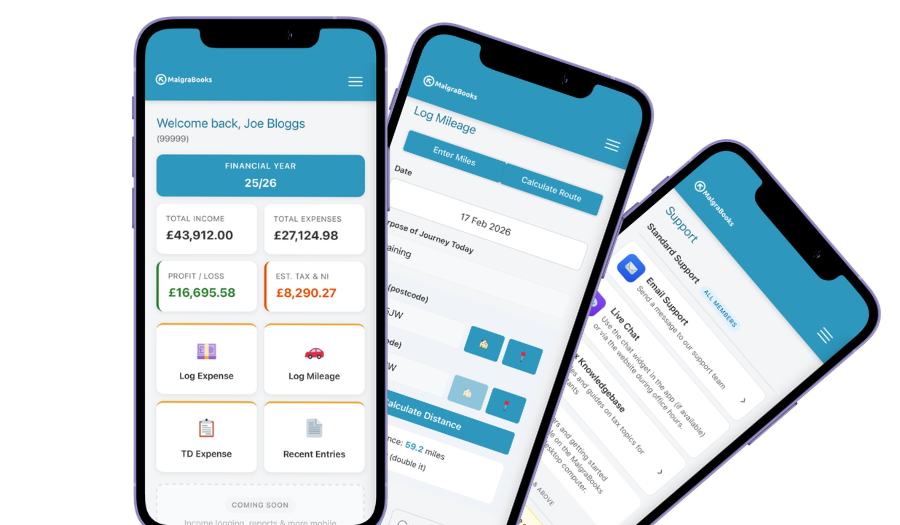
Access your accounts on your mobile
Designed for iPhone and Android phones, so you can add a payment, log a journey or scan a receipt between jobs, and check your reports and tax as you go.
See the mobile appHow Pulse helps
Pulse is our online bookkeeping system, with apps for iPhone and Android. Here’s what counsellors and therapists use most.
Recurring invoices
A client who comes every Tuesday at ten can be invoiced weekly, every 4 weeks or monthly. Set it up once and Pulse sends it automatically, or saves it as a draft for you to check first.
Recurring invoicesPay online button
Add your Stripe, SumUp or PayPal.Me link and clients can pay from the invoice, so money doesn’t have to change hands at the end of a session. It goes straight to you.
Online paymentsBlock bookings
Put a block of six sessions on one invoice. If the client pays half now and half later, Pulse records each part payment and shows what’s still owed.
Marking an invoice as paidHours at home
Log the time you spend on online sessions, notes and admin at home. Once you reach 25 hours in a month, Pulse works out the flat rate you can claim.
Working from homeScan your receipts
Photograph the receipt for a CPD workshop, your room hire or a box of tissues for the room in the app, and it’s saved against the expense.
Receipt scannerStraight to HMRC
Pulse is recognised by HMRC for Making Tax Digital. Send your quarterly updates from Pulse, and your tax return if you choose that package.
Sending MTD updatesEverything in one package
Small Business Complete includes everything on this page. There are no invoice limits, and you can start partway through the year and add the months you've missed.
MalgraBooks is recognised by HMRC for Making Tax Digital. HMRC reference D5P1NR.
Small Business Complete
- Bookkeeping, invoicing and mileage in Pulse
- Unlimited receipt scanning
- Making Tax Digital quarterly updates
- Your tax return sent to HMRC
Questions counsellors and therapists ask us
I see a few private clients alongside my job. Do I need to register?
If your private practice brings in more than £1,000 in a tax year before any costs, yes, even if you have a job as well. The Autumn Budget 2026 plans to raise it to £3,000 from 6 April 2027, once the law is passed. You need to register by 5 October after the end of the tax year you started in. For example, if you started seeing private clients in June 2026, that’s by 5 October 2027. How to register with HMRC
An EAP or agency sends me clients as well. How do I record that?
If they pay you as self-employed, add each payment in Pulse as income, the same as a private client, and keep the remittance or statement they send. It all counts towards your turnover for Making Tax Digital. If they pay you through payroll with tax taken off, it’s employment income instead and stays out of your self-employed records. Ask us if you’re not sure which applies.
A client paid for a block up front, or I charged for a missed session. When is that income?
Most sole traders use the cash basis, which has been the default since April 2024. You record the money when it comes in, even if some of the block falls next month or in the next tax year. A late cancellation fee is income too, the same as a session fee.
Do I need to pay the ICO data protection fee?
The Information Commissioner’s Office says organisations, including sole traders, that use personal information need to pay a data protection fee unless they’re exempt. Its fee checker on ico.org.uk tells you whether you need to. If you pay it, the fee is an allowable expense, so add it in Pulse with the receipt.
I get clients through a website or app. Will HMRC know what I earn?
Since 1 January 2024, websites and apps that arrange services and handle the payment have had to report some sellers’ earnings to HMRC, and they must give you a copy. A report doesn’t mean you owe extra tax if those fees are already in your records. A listing on a directory you pay for is a marketing cost. Digital platform rules on GOV.UK
How long do I need to keep my records?
At least five years after the 31 January deadline for that tax year. That’s your financial records, like invoices, receipts and mileage. Records and receipt photos in Pulse count, so you don’t need paper copies as well. How long you keep client notes is a separate question, covered by your professional body’s guidance. Keeping records
Got a question that isn't here? Send us a message and the team will get back to you.