
Bookkeeping and tax for foster carers
Your fostering allowance comes in every week or two, and most of it goes straight back out on school shoes, swimming, the food shop and the school run. HMRC treats foster carers as self-employed, but with their own tax rules, so most households have no tax to pay on fostering at all. You still need to register, keep a record of what you’re paid and send a tax return. Pulse keeps that simple.
- Record each allowance and fee payment in a minute
- Keep receipts and miles, in case you ever need your actual costs
- Send your tax return to HMRC on the package that includes it
Joanne’s week
Foster carer-
HomeMonday, school run at 8:20am
-
Fostering allowancePaid into the bank for the week by the fostering service£560
-
School runs, Monday to Friday1 mile each way, there and back twice a day20.0 miles over the week
-
Leisure centre, SaturdaySwimming lessons for the children, £12, receipt scanned2.5 miles from home
-
High streetNew school shoes, £30, receipt scanned1.0 miles
-
Back homeSaturday lunchtime2.5 miles
Making Tax Digital and foster carers
Making Tax Digital for Income Tax means keeping digital records and sending HMRC an update every three months. At the Budget on 28 October 2026, the government said it will exempt people who are eligible for qualifying care relief until further notice. The rules to make that happen are due before April 2027.
Foster carers were already exempt for 2026/27. It’s automatic if your 2024/25 tax return claimed qualifying care relief, and you can apply to HMRC if you expect to claim it for 2025/26 or 2026/27 instead.
What it means for you. Most foster carers won’t need to send quarterly updates. You still need to keep a record of what you’re paid and send a tax return each year. So there’s still a little paperwork, just once a year rather than every three months.
If you have other self-employed or rental income as well as fostering, the detail of how the exemption works hasn’t been published yet. Ask us and we’ll keep you posted.
Read what the Autumn Budget 2026 means for you, the government’s Budget 2026 overview of tax legislation and rates (paragraph 2.37), and HMRC’s guide to exemptions from Making Tax Digital for Income Tax.
How qualifying care relief works
The question we hear most is whether the fostering allowance is taxed. Usually it isn’t, but not because it’s tax-free. You’re treated as self-employed, and instead of adding up everything you spend, you use a relief called qualifying care relief.
Your limit. It’s a fixed amount for your household, plus a weekly amount for each child for every week, or part of a week, they live with you. A week starts on a Monday. If two of you in the same home each receive fostering payments, the fixed amount is split equally between you. If you only foster for part of the year, you get part of the fixed amount.
Under the limit. Add up everything your fostering service pays you for the care, the allowance and any fee. If that’s no more than your limit, your fostering profit is nil. There’s no Income Tax or Class 4 National Insurance on it, and you don’t claim any expenses.
Over the limit. You choose, each year. Either pay tax on the amount over your limit, which is called the simplified method, or work out your profit the normal way, taking off your actual expenses. Most people pick whichever gives the lower profit.
Who it covers. Foster care arranged through a council or fostering agency, shared lives care, and kinship and staying put arrangements set up by the council. Private fostering arrangements don’t qualify. Any other income you have, such as a job, is taxed as normal.
Read HMRC’s helpsheet HS236 Qualifying care relief and the GOV.UK page on tax arrangements for foster carers.
| Part of your limit | Amount |
|---|---|
| Fixed amount per household | £20,440 a year |
| Each child under 11 | £435 a week |
| Each child aged 11 or over | £515 a week |
| Each adult, for shared lives carers | £515 a week |
The amounts go up with inflation each April.
| Working it out | Amount |
|---|---|
| Fixed amount | £20,440 |
| 52 weeks at £435 | £22,620 |
| Your limit | £43,060 |
| Paid to you, £350 a week | £18,200 |
| Tax on your fostering | None |
If you’d been paid £45,060, that’s £2,000 over your limit. With the simplified method, £2,000 is your taxable profit. You’d only use actual expenses if your real costs for the year came to more than £43,060.
What you can claim as a foster carer
With qualifying care relief, you usually don’t claim individual expenses at all. The relief is there to cover them, so there’s nothing to add up and nothing to list on your tax return.
Actual expenses only come into it if what you’re paid is over your limit and your real costs for the year are higher than your limit. Then you can use the normal rules and claim costs like these, as long as they’re for fostering and not for your own family. It doesn’t happen often, because the limit is high, but keeping receipts in Pulse means you can check.
Food and household shopping
What you spend feeding the children you look after. If it’s part of the family shop, a fair share of it.
Clothes and school uniform
Clothes, shoes, coats and uniform for the children in your care.
Activities and days out
Clubs, swimming lessons, school trips, birthdays and days out with the children.
Travel
Journeys you make for fostering, like the school run and training, at 55p a mile for the first 10,000 business miles. Cars, vans and mileage
A share of household bills
The extra heating, electricity and water that comes with a bigger household, worked out on a fair basis.
Furniture and equipment
Beds, a wardrobe, car seats and stair gates. Bigger items may need to go in as a capital allowance.
Phone and broadband
The fostering share of your mobile and internet, for calls with social workers, school and the fostering service. Phone and broadband
Training and memberships
Courses, and membership of a fostering organisation, that your fostering service doesn’t pay for. Training costs
What you can’t claim
- Individual costs in a year you use the simplified method, as the relief replaces them
- Anything for your own children or the rest of your family
- Things your fostering service buys or pays for directly
- Parking and speeding fines
For how expenses work in general, see Allowable expenses, what are they?
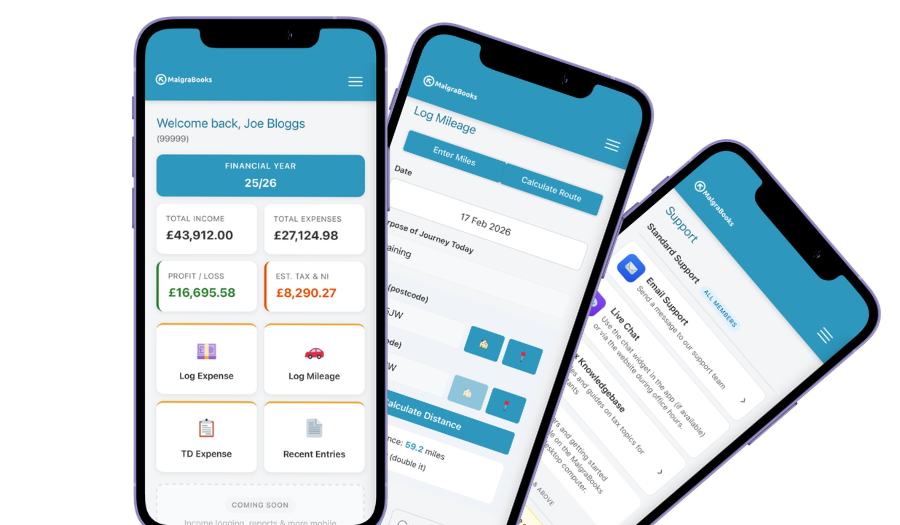
Access your accounts on your mobile
Designed for iPhone and Android phones, so you can add a payment, log a journey or scan a receipt between jobs, and check your reports and tax as you go.
See the mobile appHow Pulse helps
Pulse is our online bookkeeping system, with apps for iPhone and Android. For most foster carers, it’s about keeping a tidy record with as little effort as possible. Here’s what helps.
Every payment in one place
Add each allowance and fee payment as income when it lands, on your phone or online. At the end of the year the total is already there, ready to check against your fostering service’s statement.
The Pulse appScan your receipts
Take a photo of the receipt for school shoes, a coat or a club fee and it’s saved against the expense. If you’re ever over your limit, you can see straight away whether actual costs would help.
Receipt scannerMileage on your phone
Enter postcodes or use your location, and Pulse works out the miles for the school run, training days and trips out with the children.
Logging mileageRegular places saved
Save the school, the leisure centre and your fostering service’s office in your address book, so a journey you make every week takes seconds to log.
Address bookRegular costs remembered
A weekly club, a monthly phone bill. Add them as recurring expenses and Pulse asks you to confirm each one when it’s due, so nothing gets missed.
Recurring expensesYour tax return sent to HMRC
On the package that includes it, your tax return goes straight from Pulse to HMRC, using the figures you’ve kept through the year. Online returns are due by 31 January.
Tax return deadlinesBookkeeping and your tax return in one package
There are no invoice limits, and you can start partway through the year and add the months you've missed.
MalgraBooks is recognised by HMRC for Making Tax Digital. HMRC reference D5P1NR.
Small Business + Tax Return
- Bookkeeping, invoicing and mileage in Pulse
- 25 receipt scans a month
- Your tax return sent to HMRC
Questions foster carers ask us
Is my fostering allowance taxed?
Usually not. Everything your fostering service pays you, the allowance and any fee, counts as self-employed income, but qualifying care relief means most households have no tax to pay on it. For 2026/27 your limit is £20,440 for your household, plus £435 a week for each child under 11 and £515 a week for each child aged 11 or over. How qualifying care relief works
Do I need to register as self-employed?
Yes. GOV.UK says that when you start fostering, you need to register as self-employed and send tax returns, even if you won’t have any tax to pay. Register by 5 October after the end of the tax year you started in. For example, if you started in June 2026, that’s by 5 October 2027. How to register with HMRC
What I’m paid is under my limit. Do I still send a tax return?
Yes. You fill in the self-employment pages and claim qualifying care relief, so your fostering profit shows as nil. Your fostering service can tell you what they paid you in the year, and if you’ve added each payment to Pulse as it came in, you’ll have the figure already. Online returns are due by 31 January after the end of the tax year. Tax return deadlines
Will fostering count towards my State Pension?
With no profit, there’s no Class 4 National Insurance to pay. To protect your State Pension, you can apply for National Insurance credits as a foster carer, and kinship carers in Scotland can too. See GOV.UK’s page on National Insurance credits, and our guide to National Insurance.
I’m a shared lives carer. Do the same rules apply?
In most cases, yes. Qualifying care relief covers shared lives carers in an approved scheme, with the same fixed amount and £515 a week for each person you support. There are two differences. The relief only applies if you have no more than three placements at a time, and brothers and sisters placed together count as one. And care payments mustn’t come straight from the person you support, so check with your scheme which payments count. If you’re eligible for the relief, the Making Tax Digital exemption should apply to you too.
What records should I keep?
The payment statements from your fostering service, a note of the weeks each child lived with you and whether they were under 11 or older, and receipts for anything you spend if you might ever use actual costs. Keep them for at least five years after the 31 January deadline for that tax year. Records and receipt photos in Pulse count, so you don’t need paper copies as well. Keeping records
Got a question that isn't here? Send us a message and the team will get back to you.