
Bookkeeping and Making Tax Digital (MTD) for direct sellers and party plan
Catalogues in the car, a party on Friday night and a living room full of orders to bag up. Most direct sellers fit it around a job or a family, and the money comes in lots of small amounts. Cash on the doorstep, card payments at a party, a bank transfer from the host and a statement from the company. Pulse keeps it all in one place, from the miles to each party to your Making Tax Digital updates.
- Record party orders and payments as they come in
- Log the miles to parties and deliveries on your phone
- Send your quarterly updates and tax return straight to HMRC
Lisa’s Friday
Deliveries, then a party-
Leaves home10:00am, with last week’s party orders bagged up
-
Joan, Elm GroveDelivers her order from last week’s party, paid in cash£361.4 miles from home
-
Pat, Willow CloseCatalogue order, paid by bank transfer£242.1 miles
-
Back home12:30pm, packs the display kit for tonight2.5 miles
-
Party at Debbie’s, Ash Lane7:00pm, six guests order, paid by card on the night£1803.0 miles from home
-
Debbie’s hostess orderHer own order on top of her host rewards, paid by bank transfer£45
-
Back home10:00pm3.0 miles
When Making Tax Digital starts for you
Making Tax Digital for Income Tax means keeping your records digitally and sending HMRC a short update every three months, then a final declaration after the tax year ends. Whether you're in depends on your turnover, the total you charge your customers before any expenses, not your profit.
- From 6 April 2026Over £50,000Already started
- From 6 April 2027Over £30,000Based on your 2025/26 tax return
- From 6 April 2028Over £20,000Based on your 2026/27 tax return
An example. You’re a mobile hairdresser and your clients pay you £17,000 over the year. You also sell through party plan, where customers pay you £4,000 for their orders and the company pays you £500 in commission. Together that’s £21,500 of self-employed turnover, before you take off anything you spent. It’s over £20,000, so if your 2026/27 tax return shows that, you’ll need to use Making Tax Digital from 6 April 2028.
The quarterly updates are due by 7 August, 7 November, 7 February and 7 May. If you have other self-employed work or rent out a property, that income counts towards the total too. When do I need to start?
Is it a business, and what counts as income?
Most of what direct sellers ask us comes back to this. The rules are the same whichever company you sell for. What changes is how the money reaches you.
Hobby or business. If you buy products to sell on at a profit, or you sell regularly, HMRC is likely to see it as trading, even if it started as a bit of fun. If you only buy for yourself and your family at a discount, that isn’t trading and there’s nothing to record.
The £1,000 trading allowance. It’s measured on your sales, not your profit. That’s everything customers pay you, plus any commission or bonuses, before you take off what you paid for products. It also covers all your self-employed income together, so if you have another business, it may already be used up.
Selling at a discount, or earning commission. If customers pay you and you pay the company, your income is the full amount customers pay, and what you pay the company is an expense. If customers pay the company and it pays you commission or a bonus, your income is what the company pays you. Lots of sellers have both, so check your statements.
Starter kits, samples and demo kits. A starter kit is a business cost once you’re trading. So are samples you give away and products you open for guests to try at a party. Anything from the kit that ends up in your own bathroom or kitchen is personal, so leave that part out.
Stock at the end of the year. Most sole traders use the cash basis, which is now the standard way for HMRC. You claim products when you pay for them, so there’s no need to count what’s left in the cupboard on 5 April. With traditional accounting, unsold stock is counted at the year end.
Products for your own use. On the cash basis, simply leave them out of your expenses, or take them back out of the order. With traditional accounting, goods you take for yourself are added back at their normal selling price. HMRC’s guidance covers both, so ask us if you’re not sure which you use.
Read more about stock and goods for resale, the trading allowance on GOV.UK and allowable expenses.
| How it works | Your income |
|---|---|
| Customers pay you, you pay the company | The full amount customers pay |
| Customers pay the company, it pays you | What the company pays you |
| A mix of both | Both, added together |
Your turnover decides when Making Tax Digital applies, so it needs to be the right figure, not just what was left over.
| Item | In your books |
|---|---|
| Commission and cash bonuses | Income |
| Starter kit, when you’re trading | Expense |
| Samples you give away | Expense |
| Demo products used at parties | Expense |
| Products for you and your family | Not an expense |
| A discount on your own order | Nothing to record |
Selling with a particular company?
The rules above apply to everyone. Here are a few things that come up for sellers with some of the companies our members mention most, in A to Z order. Your own agreement and statements always come first, so check how your company pays you.
Arbonne
Arbonne calls its sellers Independent Consultants. If your customers order online through your Arbonne website and the company sends the products to them, their orders aren’t your sales. Your income is what Arbonne pays you, so add the full amount from each statement. If you also buy products and sell them on yourself, those sales count too.
Avon
Avon calls its sellers Reps. When customers pay you the brochure price, the full amount is your income and what you pay Avon is an expense. Brochures, bags and samples you pay for are business costs. Read our full page for Avon representatives.
Forever Living
Forever Living calls its sellers Forever Business Owners, and you can buy products at a discount to sell on. If your first box of products is partly for customers and partly for you, only claim the part you sell, give away as samples or use for demos. If you mainly buy for your own use, that part isn’t a business at all.
Herbalife
Herbalife’s UK information calls people who join Members, and says many only buy for themselves at a discount. If that’s you, there’s nothing to record. If you sell to customers, what they pay you is income and what you paid is an expense. Any commission or bonus from the company is income too. Once you’re trading, the Member Pack you paid to join is a business cost.
Juice Plus
Juice Plus calls its sellers Partners. Lots of partners fit it around a job, so the earnings statement is often the main thing to record. Add the full amount when it’s paid, leave out products you use at home, and keep receipts for training days that help with the business you already run. Read our full page for Juice Plus partners.
Mary Kay
Mary Kay calls its sellers Independent Beauty Consultants, and many work through beauty parties with hostess rewards. Your starter kit, catalogues and the samplers you buy to hand out are business costs. Retail-sized products you use to demonstrate at parties count too, but not once they move into your own make-up bag.
Neal’s Yard Remedies
Neal’s Yard Remedies calls its sellers independent consultants, and many sell at parties and events. If you hire a room for a workshop or an open evening, the hire is a business cost. Drinks and nibbles for your guests aren’t, because HMRC treats them as entertaining. Renting a chair, room or pitch
Oriflame
Oriflame calls its sellers Brand Partners. A bonus the company pays you is income, even if it was worked out on your own orders. A lower price on products you keep isn’t income, so there’s nothing to record for it. Read our full page for Oriflame Brand Partners.
Scentsy
Scentsy calls its sellers Consultants, and parties can be at home, online or a basket party, where the host collects orders from friends. Host Rewards come through the company’s own scheme, so they aren’t your income or your expense. A thank-you present you buy the host yourself, like flowers or wine, usually can’t be claimed.
Tropic
Tropic calls its sellers Ambassadors. Customers can shop through your own online shop and Tropic pays you commission, so your income is the commission you receive, not the value of their orders. The starter kit is a business cost. If you send it back for a refund, take the refund off the cost.
Usborne Books at Home
This is now called Usborne Community Partnerships, and its sellers are self-employed Independent Usborne Partners. If you take a stall at a school fair or a pop-up event, the stall fee and the miles are business costs. Display copies you use at events are business stock. Books from your orders that you keep for your own children are personal.
Utility Warehouse
Utility Warehouse calls its sellers Partners. Your customers pay their bills to the company, not to you, so their bills aren’t your turnover. Your income is what the company pays you, including payments for customers you help switch, any share of their monthly bills and any bonuses. The registration fee and monthly fee are business costs. Your own household bills are personal, apart from the business share of your phone and broadband.
Younique
Younique sellers mostly sell online, through social media and live demos. If customers order through your link and the company pays you, your income is what you’re paid. A ring light or phone stand you buy for your live demos can usually be claimed, along with the business share of your phone and data. Make-up you’d wear anyway is personal, even if you wear it on a live.
What you can claim as a direct seller
Every allowable expense brings down the profit you pay tax and National Insurance on. These are the ones direct sellers and party plan sellers claim most. Keep the receipt or order confirmation for each, or scan it into Pulse.
Products you sell
What you pay the company for customers’ orders. Leave out anything in the same order that was for you. Stock and goods for resale
Starter kit and fees
Your starter kit, plus any joining, renewal or monthly fee the company charges you to keep selling.
Catalogues and adverts
Catalogues and brochures you pay for, order forms, business cards and paid social media posts. Marketing costs
Samples and demo products
Samples you hand out, and products you open for guests to try at parties, as long as they don’t end up as yours.
Bags, packaging and postage
Gift bags, tissue paper, labels and the postage when you send an order to a customer who lives further away.
Miles to parties and deliveries
55p a mile for the first 10,000 business miles in a car, then 25p. That covers fuel, insurance and wear and tear. Cars, vans and mileage
Phone and data
The business share of your mobile and internet, for party invites, customer messages and placing orders. Phone and broadband
Sorting orders at home
If you spend 25 hours or more a month bagging up orders and doing admin at home, you can claim a flat rate of £10 to £26 a month. Simplified expenses
What you can’t claim
- Products for you or your family, even if you bought them at a discount
- Demo products you end up using yourself
- Drinks and nibbles for party guests
- Flowers, wine or other thank-you presents for your host
- Fuel for your car if you claim mileage for it
- Your actual costs, if you’ve taken off the £1,000 trading allowance instead
For the full list, see Allowable expenses, what are they?
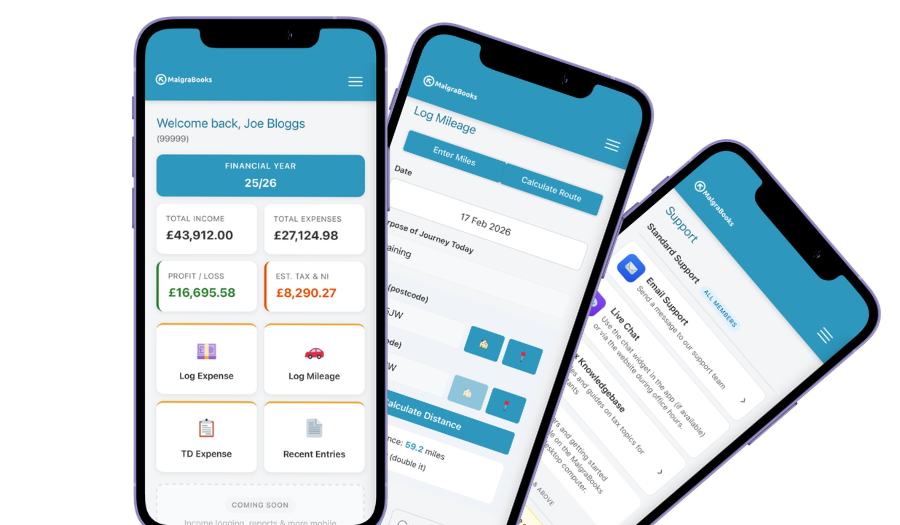
Access your accounts on your mobile
Designed for iPhone and Android phones, so you can add a payment, log a journey or scan a receipt between jobs, and check your reports and tax as you go.
See the mobile appHow Pulse helps
Pulse is our online bookkeeping system, with apps for iPhone and Android. Here’s what direct sellers use most.
Party orders on invoices
Pop each guest’s order on an invoice from your phone and put the party in the description. Mark it paid when the money comes in, and you can see at a glance who still owes you.
Marking an invoice as paidPay online
Guests who order after the party can pay from the invoice. Add your Stripe, SumUp or PayPal.Me link and a Pay online button appears. The money goes straight to you, and part payments are tracked.
Online paymentsMiles to parties
Enter postcodes or use your location, and Pulse works out the miles. Save your regular hosts and customers in the Address Book so each delivery takes seconds to log.
Address BookScan your receipts
Photograph the receipt for gift bags or postage, or a screenshot of your order confirmation, and it’s saved against the expense. Handy when one order is split between customers and you.
Receipt scannerMonthly fees remembered
A monthly fee to the company, your website or your phone contract comes round like clockwork. Add them as recurring expenses and Pulse asks you to confirm each one when it’s due.
Recurring expensesStraight to HMRC
Pulse is recognised by HMRC for Making Tax Digital. Send your quarterly updates from Pulse, and your tax return if you choose that package.
Sending MTD updatesEverything in one package
Small Business Complete includes everything on this page. There are no invoice limits, and you can start partway through the year and add the months you've missed.
MalgraBooks is recognised by HMRC for Making Tax Digital. HMRC reference D5P1NR.
Small Business Complete
- Bookkeeping, invoicing and mileage in Pulse
- Unlimited receipt scanning
- Making Tax Digital quarterly updates
- Your tax return sent to HMRC
Questions direct sellers ask us
I only joined for the discount. Do I need to register?
Not if you only buy for yourself and your family. Once you start selling, add up what customers pay you and anything the company pays you, before costs. If that’s more than £1,000 in a tax year, you need to register by 5 October after the end of the tax year you started in. For example, if you started in May 2026, that’s by 5 October 2027. How to register with HMRC
I sell for two companies. How does that work?
Both count as self-employed income. The £1,000 trading allowance covers them together, not one each, and for Making Tax Digital the turnover from both is added up. Keep each company’s statements separate so you can match them to your income. If you’re not sure how to set it up, ask us.
Guests paid by card at the party. What do I record?
Record the full amount each guest paid as income. The fee your card reader takes off is a separate expense, so don’t just record what reached your bank. Card payment charges
My host got free products. Do I put them in my books?
If the company gives them to your host through its own rewards scheme, there’s nothing for you to record. If you give your host something from your own stock or buy them a present, ask us before you claim it, because HMRC has strict rules on gifts.
I have a job as well. Do my wages count towards Making Tax Digital?
No. Only your self-employed turnover and any rental income count towards the limits. Your wages still count when your tax bill is worked out, but they don’t decide whether you need to start. When you need to start
How long do I need to keep my statements and receipts?
At least five years after the 31 January deadline for that tax year. That includes order confirmations and statements from the company. Receipt photos in Pulse count, so you don’t need to keep paper copies as well. Keeping records
Got a question that isn't here? Send us a message and the team will get back to you.
The company names on this page are trade marks of their owners. MalgraBooks isn’t connected with any of these companies.