
Bookkeeping and Making Tax Digital (MTD) for self-employed taxi and private hire drivers
Airport runs, the Friday night rush, a school contract in the mornings and plenty of waiting in between. Some passengers pay cash, some tap a card, and a lot of work comes through an app that pays you weekly with its commission already taken off. Pulse keeps your fares, your miles and your Making Tax Digital updates in one place, whether you drive a hackney carriage or a private hire car.
- Log each shift’s miles on your phone before you go to bed
- Keep cash, card and app fares together in one set of books
- Send your quarterly updates and tax return straight to HMRC
Ravi’s Friday
5pm to 10pm, local firm and an app-
Leaves home4:45pm, logged on with the firm and the app
-
Mr Hughes, Withington to the airportBooked through the local firm, paid by card£3213.0 miles from home, pick-up and trip
-
Airport to the city centreAn app job, paid in the weekly payout£2810.0 miles
-
Deansgate to DidsburyAnother app job, three friends heading home for tea£186.5 miles, pick-up and trip
-
Mrs Doyle, Chorlton to SaleLocal firm, £14 in cash including a £2 tip£145.0 miles, pick-up and trip
-
Back home10:15pm3.5 miles
When Making Tax Digital starts for you
Making Tax Digital for Income Tax means keeping your records digitally and sending HMRC a short update every three months, then a final declaration after the tax year ends. Whether you're in depends on your turnover, the total you charge your customers before any expenses, not your profit.
- From 6 April 2026Over £50,000Already started
- From 6 April 2027Over £30,000Based on your 2025/26 tax return
- From 6 April 2028Over £20,000Based on your 2026/27 tax return
An example. You drive five or six shifts a week and take about £900 a week in fares, tips included, for 46 weeks of the year. That’s 46 × £900, or £41,400 of turnover. Turnover means the full fares your passengers pay, before the app’s commission, your operator’s fee or any car costs come off. It’s over £30,000, so if your 2025/26 tax return shows that, you’ll need to use Making Tax Digital from 6 April 2027.
The quarterly updates are due by 7 August, 7 November, 7 February and 7 May. If you have other self-employed work or rent out a property, that income counts towards the total too. When do I need to start?
Your car: mileage rate or actual costs?
A full-time driver can do 30,000 miles a year, so the car is the biggest cost in the business by a long way. How you claim for it is the choice we’re asked about most, and it’s one you live with for as long as you keep the car.
The mileage rate. You claim a flat amount for every business mile. It covers fuel, insurance, servicing, repairs, tyres and the cost of the car itself, so all you need is a good mileage log. Parking, tolls and airport drop-off charges go on top.
Actual costs. You add up what the car really costs to run, such as fuel, hire and reward insurance, servicing, repairs, tyres and vehicle tax. You then claim capital allowances on the car itself, spread over the years. A car with CO2 emissions of 50g/km or less gets 14% a year, anything higher gets 6%, and a brand new electric car can currently be claimed in full in the first year. Only the business share of all of it counts.
Which suits a full-time driver? It’s often closer than people think. With an economical hybrid, the mileage rate can match or beat actual costs, with far less paperwork. Actual costs tend to come out ahead with a new electric car, a pricey car, a heavy repair bill or very high insurance. The choice sticks. Once you’ve used the mileage rate for a car, you keep using it, and once you’ve claimed capital allowances on a car, you can’t move to the mileage rate. So ask us before your first tax return with a new car.
Purpose-built cabs. HMRC’s mileage rate isn’t available for cars designed for commercial use, and gov.uk gives black cabs as the example. If yours is an ordinary saloon, estate or people carrier licensed as a hackney carriage or private hire car, the mileage rate is usually open to you. Wheelchair-accessible conversions are less clear cut, so ask us. HMRC guidance on the mileage rate (gov.uk)
Your private miles. Fares, driving to pick-ups, running back empty and moving between ranks are business. The school run, the big shop and a weekend away aren’t. If you claim actual costs, note the reading on the clock at the start and end of the tax year and work out the business share from your mileage log. 28,800 business miles out of 32,000 is 90%.
Licence, badge and operator fees. Your council driver’s licence or badge, the DBS check and medical it needs, and any knowledge test are costs of your trade, so they go in on top of either method. So does a weekly fee to your operator or base. The vehicle licence (the plate) and council vehicle tests are tied to the car, so if you use the mileage rate, ask us how to treat them.
Commission is an expense. If you work through an app such as Uber or Bolt, or an operator that takes a cut, your income is the full fare the passenger paid. The commission or service fee comes off as an expense. Check your weekly statement, as it usually shows the fares, tips and fees separately. Recording the payout alone makes your turnover look smaller than it is.
The apps tell HMRC. Since 1 January 2024, digital platforms have had to report what they pay the people who earn through them, and gov.uk gives driving a taxi as an example. The first reports went to HMRC by 31 January 2025. The platform must give you a copy of what it reports. That doesn’t mean you owe tax, but HMRC can see your figures, so make sure yours match. Selling goods or services on a digital platform (gov.uk)
Read more about cars, vans and mileage, capital allowances and simplified expenses.
| 2026/27 | Claim |
|---|---|
| First 10,000 miles at 55p | £5,500 |
| Next 18,800 miles at 25p | £4,700 |
| Mileage rate claim | £10,200 |
From 6 April 2027 the rate after 10,000 miles is due to rise from 25p to 35p, subject to legislation. The same miles would then give £12,080. Autumn Budget 2026
| Cost for the year | Amount |
|---|---|
| Fuel | £5,000 |
| Hire and reward insurance | £2,500 |
| Servicing, repairs and tyres | £2,200 |
| Vehicle tax, plate and vehicle tests | £400 |
| Capital allowance, £18,000 hybrid at 6% | £1,080 |
| Total | £11,180 |
| Business share, 90% | £10,062 |
Here the car does 32,000 miles in the year and 28,800 are for work. The mileage rate comes out £138 ahead, with no fuel receipts to keep. A new electric car, or a big gearbox bill, could tip it the other way.
| Cost | On top? |
|---|---|
| Driver’s licence or badge, DBS check, medical | Yes |
| Operator fee or app commission | Yes |
| Parking, tolls, airport charges | Yes |
| Fuel, insurance, repairs | No |
| Vehicle licence (plate) | Ask us |
What you can claim as a taxi or private hire driver
Every allowable expense brings down the profit you pay tax and National Insurance on. These are the ones taxi and private hire drivers claim most. Keep the receipt or statement for each, or scan it into Pulse.
Your car
Either the mileage rate for each business mile, or the business share of actual running costs plus capital allowances. One method per car. Cars, vans and mileage
Council licence fees
Your driver’s licence or badge, the DBS check and medical that go with it, and any knowledge or local area test the council sets.
Operator fees and commission
The weekly fee you pay your base or operator, and the commission or service fee an app takes from each fare.
Insurance
Hire and reward cover, if you claim actual costs. On the mileage rate it’s already part of the rate. Public liability cover is separate and can go in either way.
Phone and data
The business share of your phone contract and data, plus a phone mount and charging cable for the dashboard. Phone and broadband
Parking, tolls and airport charges
Airport drop-off and pick-up charges, bridge and tunnel tolls and congestion charges on fares, even if you claim mileage. Parking charges
Card payment fees
The fees SumUp, Square and similar take when a passenger taps a card in your car. Card payment charges
Training
Courses your council asks for, like safeguarding or disability awareness, and training that builds on your driving work. Training costs
What you can’t claim
- Fuel, insurance, servicing or tyres for a car you claim the mileage rate for
- Private miles, like the school run or a trip to see family, even in the licensed car
- Parking tickets, bus lane fines and speeding fines
- Everyday clothes, even a shirt and trousers you only wear to drive
- Food and drink you buy for yourself while you wait between jobs
- Your actual costs, if you’ve taken off the £1,000 trading allowance instead (due to rise to £3,000 from 6 April 2027)
For the full list, see Allowable expenses, what are they? and parking, tolls and fines.
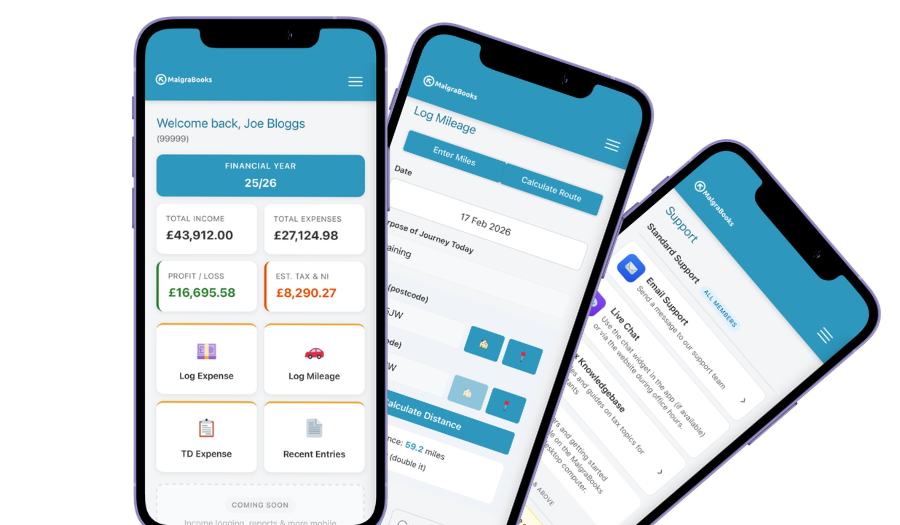
Access your accounts on your mobile
Designed for iPhone and Android phones, so you can add a payment, log a journey or scan a receipt between jobs, and check your reports and tax as you go.
See the mobile appHow Pulse helps
Pulse is our online bookkeeping system, with apps for iPhone and Android. Here’s what taxi and private hire drivers use most.
Mileage on your phone
Enter postcodes or use your location, and Pulse works out the miles. Save the airport, the station and your usual rank in the Address Book, so a whole shift takes a minute to log.
Address BookRegular costs remembered
Your weekly operator fee, monthly insurance and phone contract come round like clockwork. Add them as recurring expenses and Pulse asks you to confirm each one when it’s due.
Recurring expensesScan your receipts
Photograph the receipt for your badge renewal, an airport car park or a new set of tyres, and it’s saved against the expense before it disappears down the side of the seat.
Receipt scannerSchool runs and account work
Drive a school contract or a regular run for a local business? Set up a weekly or monthly recurring invoice, and Pulse sends it automatically or saves a draft for you to check.
Recurring invoicesQuotes for bigger jobs
Asked for a price on a wedding, a long-distance run or a group to the airport and back? Send a quote, and when they say yes, turn it into an invoice in one click.
QuotesStraight to HMRC
Pulse is recognised by HMRC for Making Tax Digital. Your cash, card and app fares and your costs come together in your quarterly updates, and you can send your tax return too if you choose that package.
Sending MTD updatesEverything in one package
Small Business Complete includes everything on this page. There are no invoice limits, and you can start partway through the year and add the months you've missed.
MalgraBooks is recognised by HMRC for Making Tax Digital. HMRC reference D5P1NR.
Small Business Complete
- Bookkeeping, invoicing and mileage in Pulse
- Unlimited receipt scanning
- Making Tax Digital quarterly updates
- Your tax return sent to HMRC
Questions taxi and private hire drivers ask us
I only drive a few nights a week alongside my job. Do I need to register?
If your self-employed income adds up to more than £1,000 in a tax year before any costs, yes, even with a job as well. That limit is due to rise to £3,000 from 6 April 2027. You need to register by 5 October after the end of the tax year you started in. If you started driving in June 2026, that’s by 5 October 2027. How to register with HMRC
The app pays me after taking its cut. Which figure is my income?
The full fares your passengers paid, plus any tips. The commission or service fee then goes in as an expense, so your profit comes out the same, but your turnover is right. Turnover is what decides when you need Making Tax Digital, so it matters. Your weekly statement usually splits the fares, tips and fees out for you.
The app’s yearly summary doesn’t match my own figures. Which is right?
Often both are, for different dates. Platforms report to HMRC by calendar year, January to December, but your tax return runs from 6 April to 5 April. Use your own records of fares and fees for the tax year. If the totals still don’t match, look for tips, bonuses or charges you’ve missed.
Can I claim the drive from home at the start of a shift?
Usually, yes, if you run the business from home and your jobs take you all over. The drive to your first pick-up and home after your last fare are normally business miles. If you always start and finish at the same office or base, that can look more like commuting, so ask us first. Cars, vans and mileage
Do I need to register for VAT?
Only if your own turnover goes over £90,000 in any rolling 12 months, and most self-employed drivers are well under that. The Autumn Budget 2026 announced VAT changes for private hire operators from 2 January 2028, subject to legislation, and the details are still being worked out. If you run your own small operator business, ask us. VAT explained
How long do I need to keep my records?
At least five years after the 31 January deadline for that tax year. That’s your mileage log, app and operator statements, and receipts. Records and receipt photos in Pulse count, so you don’t need paper copies as well. If you also do food or parcel deliveries between fares, see our page for delivery drivers and couriers. Keeping records
Got a question that isn't here? Send us a message and the team will get back to you.
Uber and Bolt are trade marks of their owners. MalgraBooks isn’t connected with either.