
If you clean for a living, you probably spend part of every day in the car. Short hops between clients soon add up, and so does what you can claim for them. So can you claim the miles? For most self-employed cleaners, yes, and often more of them than you’d think.
Here’s what counts, what doesn’t, and what a year of miles can be worth. For everything else about running your books, see our guide for self-employed cleaners.
The short answer
Driving from one client to the next is business travel. You can claim it.
The drive from home to your first client, and back from your last one, usually counts too. Most mobile cleaners run the business from home and travel out to different clients’ houses. Home is the base, and each client’s home is simply where that job happens to be.
HMRC’s own manual covers this. It describes an “itinerant” trader as one who travels from home “to a number of different locations” to do a job of work at each. Where that trader’s base is their home, it says “you should allow the costs of travelling between the residence and the sites at which the trader works”. You can read it in HMRC’s guidance on travel to and between sites. Plenty of cleaners work in just this way.
When it doesn’t count
The general rule is that travel between home and your place of work is ordinary commuting, and you can’t claim it. The trip from home only becomes business travel when home really is the base you work from.
So it’s different if most of your work is one regular contract in one place. Say you clean the same office for one company every weekday. That office starts to look like your place of work, and the drive there and back can be treated as commuting.
Every case depends on the facts. If this sounds like you, ask us before you claim it.
Other trips that count
It isn’t only drives to clients. A trip you make just for the business can count too, for example:
- going to the wholesaler to stock up on cleaning products
- picking up a new vacuum, or dropping one off for repair
- paying your cash takings into the bank
- visiting a new client to give them a price
Anything personal doesn’t count. If you drop the children at school before your first client, or do the family shop on the way home, the extra miles aren’t business. Only claim the miles the work journey would have taken on its own.
The mileage rates for 2026/27
You don’t need to keep every fuel receipt. Instead, you can claim a flat rate for each business mile in a car or van:
- 55p a mile for the first 10,000 business miles in the tax year
- 25p a mile for every mile after that
The 55p rate is new. It was 45p before, and the higher rate applies from 6 April 2026. If you ride a motorbike, the rate is 24p a mile.
The flat rate covers the cost of running the vehicle, such as fuel, insurance, servicing, MOT, road tax and wear and tear. So if you claim mileage, you don’t claim those costs as well. Once you use the flat rate for a vehicle, you keep using it for as long as you use that vehicle for work. The rates are on gov.uk.
What Sam’s miles are worth
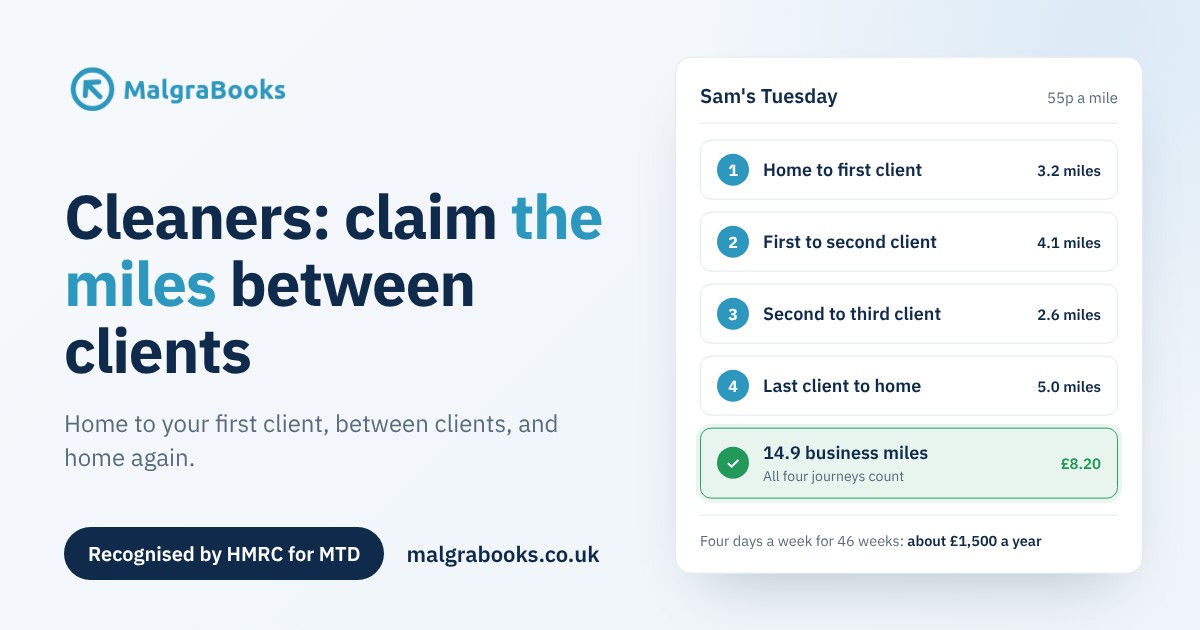
On our cleaners page, we follow Sam through a Tuesday. Sam drives 3.2 miles from home to the first client, then 4.1 and 2.6 miles between clients, and 5.0 miles home at the end of the day. That’s 14.9 business miles, worth £8.20 at 55p.
£8.20 doesn’t sound like much. But say Sam works a day like that four times a week, for 46 weeks of the year:
- 14.9 miles × 4 days = 59.6 miles a week
- 59.6 miles × 46 weeks = 2,741.6 miles a year
- 2,741.6 miles × 55p = £1,507.88
That’s about £1,500 a year off the profit Sam pays tax and National Insurance on. Sam is well under 10,000 miles, so every mile is at 55p.
Now leave out the first and last trip of each day. Sam’s claim drops to 6.7 miles a day, or about £678 for the year. That’s why it pays to know if your trips from home count.
Parking is extra, fines aren’t
If you pay to park near a client’s home, you can claim that on top of your mileage. Keep the receipt, or a screenshot from the parking app. Parking fines and penalty charges can’t be claimed, even if you got one while you were working. There’s more in our guide to cars, vans and mileage.
Keep a simple log
Write your journeys down as you go, rather than guessing at the end of the year. For each one, note:
- the date
- where you went from and to
- how many miles
- what it was for, such as the client’s name
Keep your log with the rest of your records for at least five years after the 31 January deadline for that tax year. Here’s more on how long to keep records.
How Pulse helps
The mileage log in the Pulse app does the sums for you. Enter the postcodes, or use your location, and Pulse works out the miles. See how to log mileage.
Save each regular client in your Address Book, and logging a round like Sam’s takes a few taps. You can also snap your parking receipts with the receipt scanner, so they’re saved against the expense.
More for cleaners
Our page for self-employed cleaners covers the rest, from what you can claim to recurring invoices for weekly clients and Making Tax Digital. When you’re ready, see our small business pricing.
Not sure if your journeys count? Just ask through our contact form and we’ll help.
