
It happens to everyone. You pay £45 to purchase some essential stationery items, the receipt goes in your coat pocket, and by the end of the month it’s gone.
Or it’s still there, but the print has faded to a blank strip of paper.
One lost receipt isn’t the end of the world. Here’s what HMRC expects you to keep, what to do when something goes missing, and how to stop it happening again.
What records does HMRC expect?
If you’re a sole trader, you must keep records of your business income and expenses for your Self Assessment tax return. You don’t send them to HMRC, but you need them to work out your profit, and HMRC can ask to see them.
The gov.uk page on what records to keep lists these types of proof:
- all receipts for goods and stock
- bank statements and chequebook stubs
- sales invoices, till rolls and bank slips
It also says you must be able to identify business transactions. So you need to be able to show what each cost was, and that it was for your business.
Paper or digital, both are fine
HMRC’s guidance on keeping your records says “There are no rules on how you must keep records.” You can keep them “on paper, digitally or as part of a software program (like book-keeping software)”.
The catch is that HMRC can charge a penalty if your records are not accurate, complete and readable. A clear photo of a receipt is far more useful than a faded original. HMRC’s own Compliance Handbook gives photographing a purchase invoice as one way to keep a record, as it “preserves an exact replica of the original document”.
Making Tax Digital and receipts
If you’re in Making Tax Digital for Income Tax, you need to create and store digital records of your income and expenses in compatible software. Each record needs the amount, the date and a category.
MTD doesn’t do away with receipts, though. gov.uk says “You still need to keep original records or supporting documents (or copies of them).” The figures live in your software, and the receipts back them up.
Lost a receipt? Here’s what to do
HMRC’s advice for lost records is to “Try to get copies of as much as you can, for example ask banks for copies of statements or suppliers for duplicate invoices.” In practice, that means:
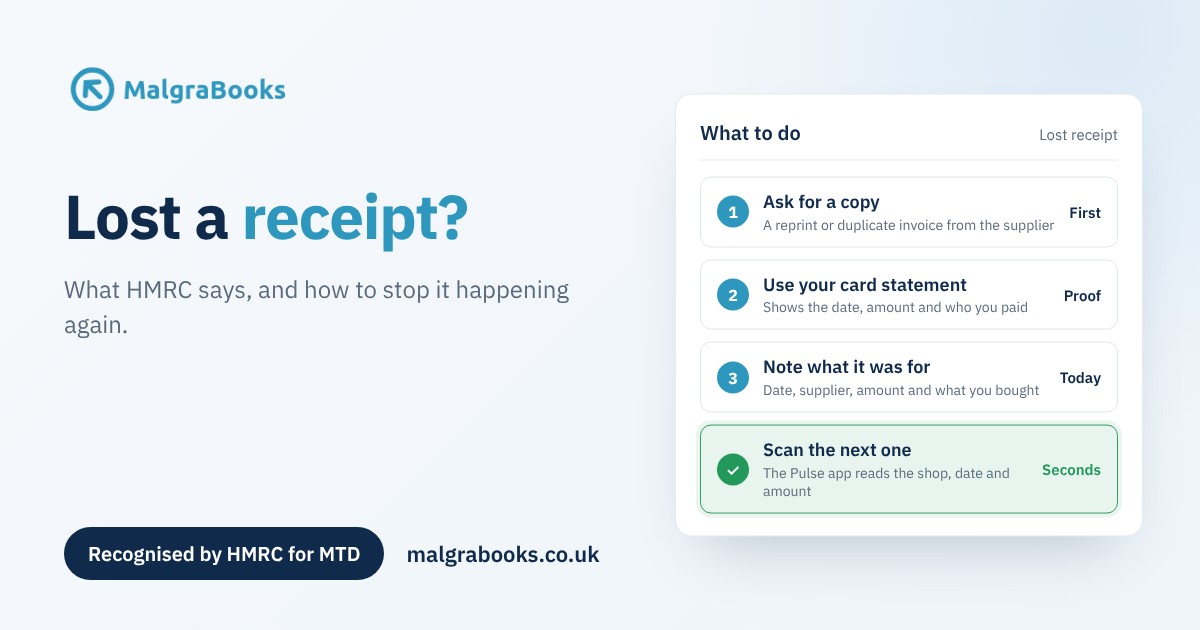
- Ask for a copy. Many shops and suppliers can reprint a receipt or send a duplicate invoice.
- Check your emails. If you bought it online, look for the order confirmation, or download the invoice from your account on the seller’s website.
- Use your card or bank statement. Bank statements are on gov.uk’s list of proof. Yours shows the date, the amount and who you paid.
- Note what it was for. Do it while you still remember: the date, the supplier, the amount and what you bought. A statement shows you paid, and your note explains why it was a business cost.
If you really can’t replace a record, gov.uk says “you must do your best to provide figures”. You can use estimated figures (your best guess) or provisional ones (while you wait for the paperwork), but you must tell HMRC when you file your tax return. With one lost receipt and a card statement, you’ll usually have the real figure anyway.
An example
Jo is a mobile hairdresser. In September she pays £45 by card to get her scissors sharpened, and loses the receipt.
She emails the sharpening service and asks for a copy. While she waits, she finds the £45 payment on her card statement and writes a note: “Scissors sharpened, 12 September, £45”. When the copy arrives, she has everything: what she paid, when, and what it was for.
Not sure what counts as a business cost in the first place? Our guide to allowable expenses explains.
Faded receipts
Lots of shops print receipts on thermal paper, which fades over time, and faster in heat or sunlight. A receipt you can’t read isn’t much help, as your records need to be readable. Photograph them as soon as you get them, and don’t leave them on the dashboard.
How long to keep your records
You must keep your records “for at least 5 years after the 31 January submission deadline of the relevant tax year”. So for your 2025/26 tax return, due by 31 January 2027, keep them until at least the end of January 2032. Our page on how long to keep records has more.
That’s a long time for a paper receipt to survive in a shoebox.
How Pulse stops it happening
The easiest fix is to deal with each receipt the moment you get it. In the Pulse app, you scan the receipt with your phone. Pulse reads the shop, the date and the amount, and suggests a category for you to check. The receipt is saved against the expense, so if the paper copy goes missing next week, it doesn’t matter.
It takes seconds, so you can do it before the receipt even reaches your pocket. Here’s how the receipt scanner works.
The short version
- Lost a receipt? Ask for a copy first.
- Use your card statement to show you paid.
- Note what it was for while you remember.
- Scan the next one as soon as you get it.
Pulse works for hairdressers, cleaners, trades and most other sole traders. Find your trade to see how it works for you, or see how Pulse works for hairdressers.
Any questions, just get in touch through our contact form and we’ll help.
