
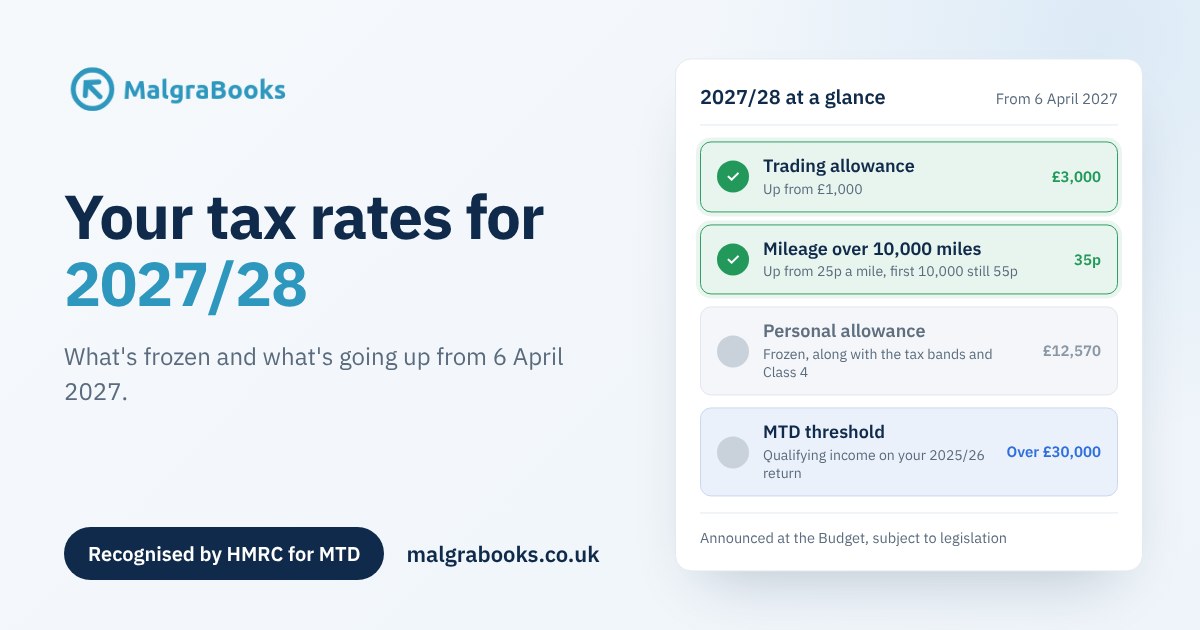
The Autumn Budget on 28 October set out the tax rates for 2027/28, the tax year that starts on 6 April 2027. A lot stays frozen, and a few things go up.
Here’s what matters if you’re a sole trader, next to this year’s figures. For the headlines, see our Autumn Budget round-up.
These were announced at the Budget and are subject to legislation, mostly through the Finance Bill, so details could still change. The figures come from the government’s Budget 2026 overview of tax legislation and rates, its rates tables, and HMRC’s current rates on gov.uk.
The rates at a glance
| What | 2026/27 | 2027/28 |
|---|---|---|
| Personal allowance | £12,570 | £12,570 |
| Basic rate, 20% | £12,571 to £50,270 | £12,571 to £50,270 |
| Higher rate, 40% | £50,271 to £125,140 | £50,271 to £125,140 |
| Additional rate, 45% | Over £125,140 | Over £125,140 |
| Class 4 National Insurance | 6% on profits £12,570 to £50,270, 2% above | No change |
| Class 2 small profits threshold | £7,105 | £7,355 |
| Voluntary Class 2 | £3.65 a week | £3.80 a week |
| Trading allowance | £1,000 | £3,000 |
| Mileage, first 10,000 business miles | 55p a mile | 55p a mile |
| Mileage, over 10,000 business miles | 25p a mile | 35p a mile |
| Working from home flat rates | £10, £18 or £26 a month | No change announced |
| Main rate writing-down allowance | 14% | 12% |
| VAT registration threshold | £90,000 | £90,000 |
| Property income rates | 20%, 40%, 45% | 24%, 44%, 49% |
| Savings income rates | 20%, 40%, 45% | 24%, 44%, 49% |
| Making Tax Digital threshold | Over £50,000 | Over £30,000 |
The income tax bands assume the standard personal allowance, and are for England, Wales and Northern Ireland. In Wales, part of the rate is set by the Senedd, so check the Welsh rates for 2027/28 once confirmed. In Scotland, the Scottish Parliament sets income tax rates and bands at the Scottish Budget, so we haven’t included Scottish figures.
Income tax and Class 4: frozen
Your personal allowance stays at £12,570, and the basic and higher rate bands don’t move. The government has already said these stay frozen until April 2031.
Class 4 National Insurance is the same story. It’s still 6% on profits between £12,570 and £50,270, and 2% above that.
So if your profit is the same next year, your bill will be too.
Class 2: small rises
If your profits are at or above the small profits threshold, Class 2 is treated as paid. You pay nothing, and your National Insurance record is protected. That threshold rises from £7,105 to £7,355.
If your profits are below it, you can choose to pay voluntary Class 2 to protect your record. That goes up from £3.65 to £3.80 a week.
The trading allowance triples
This is the big one for side businesses. From 6 April 2027, the trading allowance goes up from £1,000 to £3,000, and so does the threshold for reporting trading income through Self Assessment.
- If your total trading income is £3,000 or less before expenses, you usually won’t need to declare it or pay tax on it.
- If it’s more, you can deduct £3,000 instead of your actual expenses.
Say Holly sells handmade cards at craft fairs. Her sales are £5,000 and her costs are £800. Claiming her costs, her taxable profit is £4,200. Using the allowance instead, it’s £2,000. You can’t claim both.
Mileage: better for high-mileage drivers
The simplified mileage rate for cars and vans stays at 55p a mile for the first 10,000 business miles. Above that, it rises from 25p to 35p a mile from 6 April 2027.
Take Gareth, a delivery driver doing 15,000 business miles a year. This year he claims £5,500 for the first 10,000 miles and £1,250 for the other 5,000, so £6,750 in total. In 2027/28, the same miles are worth £7,250. That’s £500 more off his profit.
More in our mileage allowance guide. Pulse’s mileage log works out the miles from postcodes for you.
Working from home: no change
The Budget didn’t change the working from home flat rates: £10 a month for 25 to 50 hours at home, £18 for 51 to 100, and £26 for 101 or more. See our guide to simplified expenses, or use the working from home allowance in Pulse.
Capital allowances: mainly if you buy a car
The main rate writing-down allowance falls from 14% to 12% from 6 April 2027. The main rate first-year allowance for new equipment goes up from 40% to 50% for things bought from 1 January 2027.
For most sole traders, this won’t change much. On the cash basis, now the standard way for sole traders, you just claim equipment like a laptop or a lawnmower as a business expense. Capital allowances only come into it for cars.
It matters more if:
- you use traditional accounting and still claim a slice of older equipment each year, as it will be claimed more slowly. New equipment can usually still be claimed in full through the annual investment allowance, which stays at £1 million.
- you claim capital allowances on a car instead of mileage. A car with CO2 emissions of 50g/km or less, or a second-hand electric car, gets 12% a year from April 2027. Over 50g/km, it’s 6% a year, which isn’t changing.
Our guide to capital allowances has more.
VAT: no change
The VAT registration threshold stays at £90,000 of taxable turnover, and the deregistration threshold stays at £88,000.
Rental, savings and dividends
If you also have rental income, it gets its own tax rates from 6 April 2027: 24% basic, 44% higher and 49% additional. If your business already uses up your personal allowance, £5,000 of rental profit at the basic rate would cost £1,200 in tax instead of £1,000. These rates are for England, Wales and Northern Ireland, and the Scottish and Welsh governments can set their own.
Savings interest rates rise the same way, but the personal savings allowance stays at £1,000 for basic rate taxpayers and £500 for higher rate. Dividend rates and the £500 dividend allowance don’t change.
Making Tax Digital: the next wave
If your qualifying income on your 2025/26 tax return is over £30,000, you’ll need to use Making Tax Digital for Income Tax from 6 April 2027. That’s your self-employed turnover plus any property income, before expenses. From April 2028, the threshold drops to £20,000.
If you join in April 2027, you won’t get late submission penalty points for your quarterly updates in 2027/28, though you’ll still need to send all four before you can do your tax return. If you’ve been in MTD since April 2026, penalty points start from 2027/28 as planned. Foster carers and others who get qualifying care relief are exempt from MTD until further notice.
In MTD already? Your July to September update is due tomorrow, 7 November. Here’s our step-by-step guide.
Ready for April
Pulse is recognised by HMRC for Making Tax Digital and sends your quarterly updates straight to HMRC. Find your trade to see how it works for you, or view small business pricing.
Any questions about the new rates, just get in touch through our contact form and we’ll help.
