
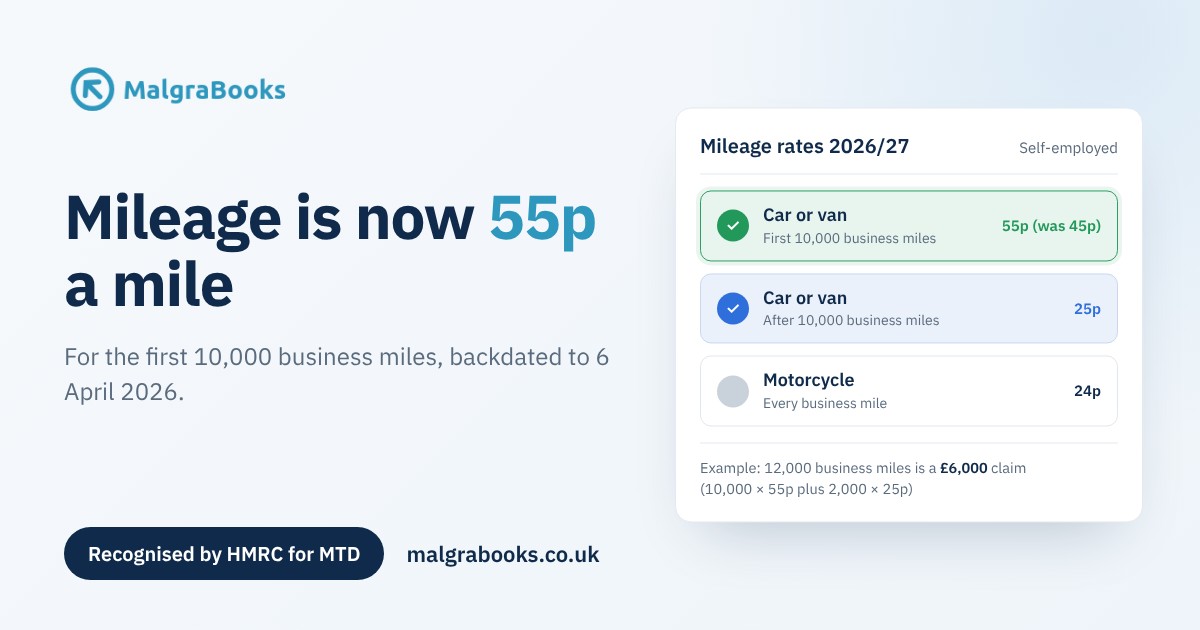
If you drive for your business, there’s some good news this year. The mileage rate for the self-employed has gone up from 45p to 55p a mile for the first 10,000 business miles. It’s the first change since 2011, and it covers the whole 2026/27 tax year, right back to 6 April 2026.
Here’s what the new rates are, what they mean in pounds, and which journeys actually count.
What’s changed, and when
The Chancellor announced the rise in her statement to Parliament on 21 May 2026, saying: “I can today announce a 10p per mile increase in tax free mileage rates, backdated to April 2026”. She said it would benefit “those who need to drive for work, from care workers to plumbers.”
The government’s policy paper on the change confirms it applies to sole traders too: “The new rates for mileage will also apply to businesses that use simplified mileage rates”. It also says: “This measure will have retrospective effect from 6 April 2026 for tax year 2026 to 2027.”
These are the flat rates for the self-employed for 2026/27:
| Vehicle | 2026/27 | Before 6 April 2026 |
|---|---|---|
| Car or van, first 10,000 business miles | 55p a mile | 45p a mile |
| Car or van, after 10,000 business miles | 25p a mile | 25p a mile |
| Motorcycle | 24p a mile | 24p a mile |
So only the first 10,000 miles in a car or van have gone up. Bicycles aren’t on the self-employed flat rate list, so for a bike you’d claim what you actually spend.
A worked example
Say you drive 12,000 business miles in your car this tax year.
- 10,000 miles at 55p = £5,500
- 2,000 miles at 25p = £500
- Total mileage claim: £6,000
At last year’s rate, the same miles would have come to £5,000 (10,000 at 45p = £4,500, plus £500). That’s £1,000 more in expenses, which means £1,000 less profit to pay tax on.
Already logged April to September at 45p?
Lots of people will have. Say you’d done 5,000 business miles by the end of September. At 45p that’s £2,250. At 55p it’s £2,750, so you’re £500 short.
HMRC’s Agent Update 143 says self-employed people can use the new rates in their 2026/27 tax return. The miles themselves don’t change, only the rate. If you keep your mileage log in Pulse, this is already done: Pulse works out every journey from 6 April at 55p, so there’s nothing to re-enter. We covered this when the change was first announced in May. If you keep a log elsewhere, check it uses 55p from 6 April.
If you’re in Making Tax Digital and your first update went with the old rate, there’s no need to resend it. Each update is a running total for the tax year, so the corrected figure simply goes into your next one.
What counts as a business journey?
This is the bit people get wrong most often. The simple rule on gov.uk is that you can’t claim for travel between home and work. HMRC’s guidance at BIM37600 onwards explains why. If you go to the same place of work every day, getting there is just ordinary commuting, because it comes from where you choose to live.
It’s different if your work moves around. BIM37620 says that where a trader who travels from place to place has their “base of operations” at home, the cost of travelling between home and the places they work is allowed. Journeys between clients or jobs during the day count too.
A few examples:
- A cleaner who runs the business from home and drives to a different set of houses each day. Home to the first house, house to house, and back home are all business miles. If you clean the same single office every day and nowhere else, that starts to look more like a commute.
- A self-employed carer who visits clients in their own homes. The trips from home to each client and between clients are business journeys.
- A hairdresser who rents a chair in a salon. Driving from home to the salon each day is commuting, so it isn’t claimable. Popping out from the salon to do a bride’s hair at her house, then back again, is a business trip.
If a journey is partly business and partly personal, only a clear business part can be claimed. Not sure about yours? Our guide to cars, vans and mileage has more detail.
Flat rate or actual costs?
You don’t have to use the mileage rate. The other way is to add up what you really spend on fuel, insurance, repairs, servicing, road tax and so on, and claim the business part. The cost of buying the vehicle then goes through capital allowances.
The flat rate is far simpler, as you only need your business miles. You can still claim parking and things like train fares on top. Two rules to know, though:
- You can’t use the mileage rate for a vehicle you’ve already claimed capital allowances on.
- Once you use the mileage rate for a vehicle, you keep using it for as long as that vehicle is in your business. You can only switch when you change vehicle.
Our guide to simplified expenses has more on the flat rates.
Keep a mileage log
HMRC expects a record made at the time, not a guess at the end of the year. For each journey, note down:
- the date
- where you went
- why you went
- how many miles you drove
Then keep those records for as long as HMRC needs. Our guide on how long to keep records explains.
Logging mileage in Pulse
Pulse has a mileage log in the app. Enter the postcodes for your journey, or use your location, and Pulse works out the miles for you. Save the places you go to often, like regular clients, in the Address Book so they’re just a tap away. Here’s our step-by-step guide to logging mileage in the app.
Logging each trip as you go means no business miles get forgotten, and your record is there if HMRC ever asks.
Not with MalgraBooks yet?
Pulse works for most sole traders who drive for work, from cleaners and carers to gardeners and plumbers. Find your trade to see how it works for you, or view our small business packages.
Any questions about your mileage, just get in touch through our contact form and we’ll help.
