
If you’ve just started working for yourself, it’s one of the first questions that comes up. Do you need a separate bank account for the business, or can you keep using the one your wages and shopping already go through?
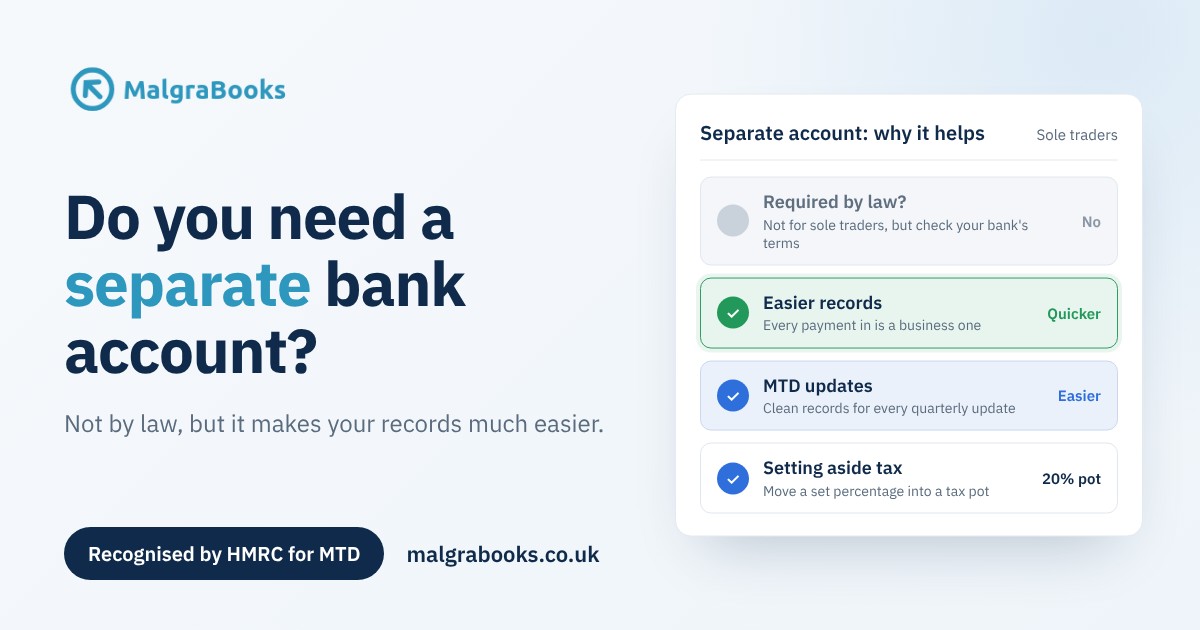
The short answer is no, the law doesn’t say a sole trader must have one. But it’s still a very good idea.
What the rules say
HMRC’s guide to business records if you’re self-employed says you might be able to use a personal or business bank account for your business. What matters is that your records are accurate and you can pick out your business income and expenses.
There is one catch. Some banks don’t allow business use of a personal account in their terms. The same gov.uk page says to check with your bank which type of account you can use, so read your own bank’s terms before you start paying customers’ money in.
Why a separate account helps anyway
This isn’t really about rules. It’s about making your life easier.
- Quicker records. Every payment in the account is a business one, so there’s nothing to pick out from the food shop and the streaming subscriptions.
- Nothing gets missed. When the account only holds business money, a payment you forgot to log stands out straight away.
- Making Tax Digital. If you’re in MTD for Income Tax, you send HMRC an update every quarter, built from digital records of your income and expenses. That’s much easier with clean records. You’re in already if your qualifying income on your 2024/25 return was over £50,000. The threshold drops to £30,000 from April 2027 and £20,000 from April 2028.
- If HMRC asks questions. You don’t send your records with your tax return, but you must keep them to show HMRC if asked. Bank statements are one of the types of proof HMRC lists. A statement with only business payments on it is far easier to explain. You need to keep records for at least 5 years after the 31 January deadline for that tax year, so it’s worth keeping them tidy.
- Setting aside tax. When business money sits in its own place, it’s much easier to see what’s yours to spend and what’s needed for the tax bill.
Which kind of account?
You’ve broadly got two choices.
A second personal current account, used only for the business, works well for many sole traders. It keeps everything apart. Just check the bank’s terms allow business use first.
A business current account is made for business use. Some charge a monthly fee or fees per transaction, and some come with extras.
Neither is right or wrong. Compare a few and pick what suits you.
How to use it well
A separate account only helps if you keep it clean. A few simple habits make all the difference.
- All business income goes in. Card payments, bank transfers and any cash you take.
- Business costs come out. Supplies, your phone, insurance, fuel. Keep the account’s card for business spending only.
- Pay yourself by transfer. When you want money for yourself, move it across to your personal account. Money you take out for your own use is known as drawings.
- Keep a pot for tax. Many people move a set percentage of every payment into a separate savings pot, say 20%. The right amount depends on your profit, so check it against your first tax return and adjust.
Don’t forget payments on account. If last year’s tax bill was £1,000 or more, you’ll usually pay towards next year’s bill too, in two payments by 31 January and 31 July, each half of last year’s bill. Our guide to payments on account explains more.
How mixed accounts go wrong
Take Ellie, a dog walker. Most clients pay by bank transfer into the joint account Ellie shares with a partner. Wages, bills and the food shop all go through it too.
At the end of the year, Ellie goes through the statements to find the business income. Two clients each paid £300 with just a first name as the reference, and Ellie takes them for money from friends. That’s £600 of income missed, and the tax return is wrong.
It goes the other way too. A client paid £200 for a month of walks, then moved away, and Ellie refunded it. Ellie counts the £200 as income but misses the refund among everything else going out. That’s tax paid on £200 that went straight back.
With a separate account, both would have been obvious.
How Pulse helps
A separate account keeps the money apart. Pulse keeps the records. In Pulse you can:
- add income and expenses on your phone or computer, as they happen
- scan receipts in the app as soon as you get them
- set up recurring expenses, like a phone contract or insurance, and Pulse asks you to confirm each one every month
- send invoices, turn quotes into invoices, and see which are paid and which are still unpaid
- add a Pay online button to your invoices, using your own Stripe, SumUp or PayPal.Me link, so customers can pay you quickly
If you’re in Making Tax Digital, Pulse sends your quarterly updates straight to HMRC from those same records.
Getting started
Pulse is recognised by HMRC for Making Tax Digital and works for most sole traders, from cleaners to gardeners. Find your trade to see how it works for you, or view our packages.
Any questions about getting your records set up, just get in touch through our contact form and we’ll help.
