
From April 2027, Making Tax Digital for Income Tax reaches a lot more sole traders. If your qualifying income on your 2025/26 tax return is over £30,000, you’ll keep digital records and send quarterly updates to HMRC from 6 April 2027. From April 2028, the line drops to £20,000. Qualifying income is your self-employed turnover plus any rental income, before expenses.
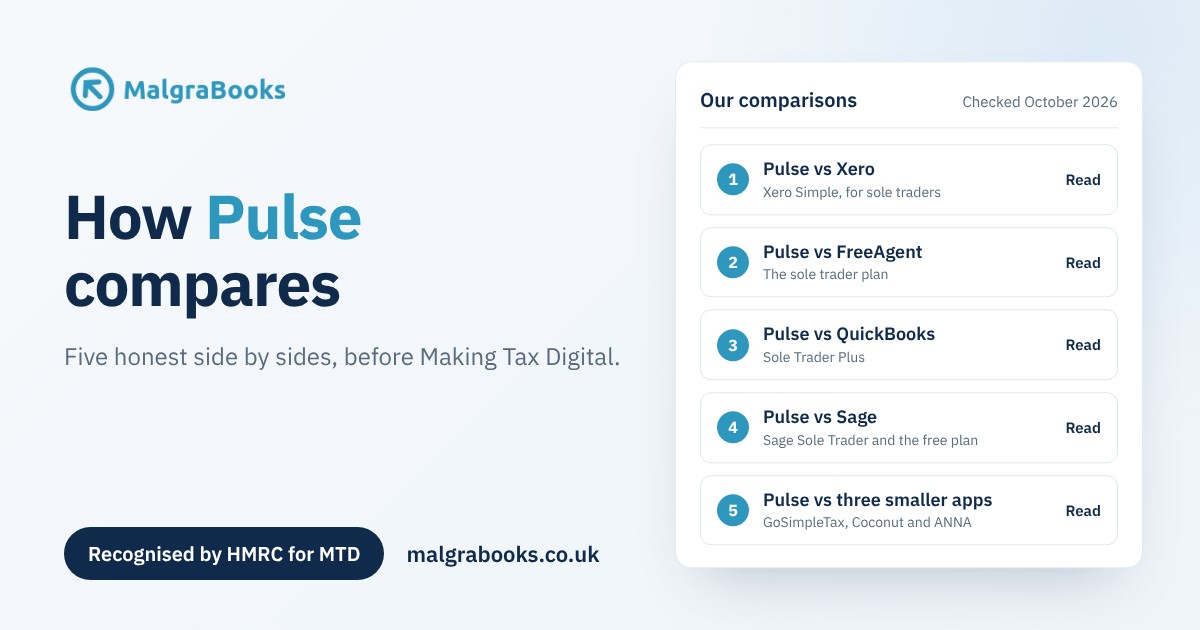
So lots of people are choosing software now. To help, we’ve written five pages that put Pulse side by side with the software sole traders ask us about most. Each one is dated, links to the other company’s own pages, and says plainly when the other option might suit you better.
What to look at when you compare
- The price including VAT. Many apps show prices plus VAT. You can reclaim VAT on business purchases if you’re VAT registered. If you’re not, a plan shown as £10 plus VAT costs you £12 a month. Our pages add the VAT, so you’re comparing like with like.
- What happens after the offer. Big discounts for the first six months are common. Look at the price for month seven, because that’s what you’ll pay for years.
- Invoice limits. Some cheaper plans cap your invoices. A cleaner with twelve regular clients would pass ten in a month. Pulse has no invoice limit.
- Mileage. If you drive for work, it’s often one of your biggest claims. At 55p a mile for the first 10,000 business miles, 2,000 miles is £1,100. In Pulse you enter postcodes or use your location, and Pulse works out the miles.
- Receipt scanning. Some apps limit how many receipts you can scan. Pulse scans 25 a month, or as many as you like on Small Business Complete.
- Your tax return. Quarterly updates aren’t the whole job, as you still have a tax return to send. Some plans include it and some don’t. Small Business Complete covers both.
Our five comparisons
Everything we say about other software comes from each company’s own website, checked on 27 October 2026. Prices and plans change, so each page links to its sources.
Pulse vs Xero
Xero Simple is Xero’s plan for sole traders who aren’t VAT registered. It includes 10 invoices, and Xero lists claiming expenses and mileage as excluded. If ten invoices is plenty and you don’t drive for work, Xero Simple costs less each month once its offer ends. Read Pulse vs Xero.
Pulse vs FreeAgent
FreeAgent’s sole trader plan includes MTD and your tax return, so we’ve put it next to Small Business Complete. It includes 10 receipt scans a month, with unlimited costing extra. FreeAgent is free with a NatWest, Royal Bank of Scotland or Ulster Bank business current account, or a Mettle account if you make at least one transaction a month. If that’s you, it’s well worth a look. Read Pulse vs FreeAgent.
Pulse vs QuickBooks
Sole Trader Plus is QuickBooks’ plan for sole traders who aren’t VAT registered. It’s 90% off for six months, then full price. QuickBooks lists recurring invoices from its Essentials plan, while every Pulse package has them. If the lowest cost for your first six months matters most, or you expect to register for VAT, QuickBooks may suit you better. Read Pulse vs QuickBooks.
Pulse vs Sage
Sage Sole Trader covers your quarterly updates and tax return. Mileage isn’t listed on Sage’s plan page, and quotes are on Sage’s Standard plan rather than Sole Trader. Sage also has a free plan with 5 invoices a month. If you send five or fewer, type in your receipts and don’t drive for work, it may be all you need. Read Pulse vs Sage.
Pulse vs GoSimpleTax, Coconut and ANNA
GoSimpleTax files your tax return, Coconut does bookkeeping and MTD, and ANNA is a business account with tax tools built in. Coconut’s help centre says it has no built-in mileage tracker. GoSimpleTax may suit you if you only need to file a return and aren’t in MTD yet, and ANNA lists free MTD filing for 2026/27 as a limited offer. Read Pulse vs the smaller apps.
Switching partway through the year
You don’t have to wait for April. When you join Pulse, you can add the earlier months of the tax year, so the whole year sits in one place.
If you’re already in MTD, it’s simpler than it sounds. Each quarterly update covers the tax year so far, from 6 April. Say you sent your November update from another app and join Pulse in December. Add your records from April onwards, and your February update covers the whole year to date, whichever software sent the earlier ones.
Not sure when MTD starts for you? Our guide on when Making Tax Digital starts explains the dates.
See them all
All five comparisons are on our How Pulse compares page, and you can find your trade to see how Pulse works for you. Still weighing it up? Ask us through our contact form. We’ll tell you honestly, even if the answer is one of the others.
